Archive for December 2011

Local in Ann Arbor: 2011

December 31, 2011

I’m not much for looking backward and don’t care much for milestones.  But there is some point, I’ll admit, to reflection on what has happened in the last year, if only to prepare for the next day and what follows. Now how best to  make sense of our recent history?  What made the year memorable from this blog’s perspective?  We’d surely not use the measurement that AnnArbor.com’s approach was to use page view numbers.  This produced a list of mostly sports-related stories, with a sprinkling of crime and tragedy.  Looking back at the year on Local in Ann Arbor, I had some posts I was really proud of but got relatively little notice, while others that got a lot of attention were not all that substantial.  Still, looking at the page view hits was instructive, and I’ve used them as a guide in this year-end review.

Honorable mentions go to posts from previous years.

Scott Trudeau (L) and Murph (R), enjoying victory ca. 2004; photo copyright by Griffin Reames, used with permission

Most irrelevantly accessed post: Ann Arbor Blogs: the Moving Finger Moves On, published in February 2010, is one of our top hits of all time.  This is not because of the brilliant writing or the subject matter (a requiem for Arbor Update), but because of the “porch couch” picture.  I get a search item for “porch couch” at least once a week, which pulls up this post with its picture.  Another example of how your history on the Internet never goes away – the student to the right, known here as Murph, is now a professional planner (Richard Murphy), whose image from 8 years ago is no longer very descriptive.  (The porch couches are now also history.)

Post which made the biggest splash and was most significant: The all-time top hit has been The Secret Plan for the Conference Center, published August 2009, which was the Ann Arbor area’s first report of a hotel-conference center proposal that had been quietly cooking along on back-office desks for over a year.

This post was the first of  a very long chain that recorded aspects of the fight over the Library Lot and what became known as the Valiant proposal.  The series, all of which has been listed on the Library Lot Conference Center page, was a major feature of this blog through 2010 and into 2011.  One of the top posts for this last year was Ann Arbor Conference Center: An Authoritative Study, where a study by a nationally-known expert on hotels and conference centers was made accessible.  The study did a pretty conclusive job of showing that the center would not be a good business risk.   The lengthy What’s in the Box (Compiled) summarized many posts analyzing the Valiant proposal as presented by the Roxbury report, which recommended this proposal for adoption.  But my favorite post is the inappropriately named And Why Are We Worried About It (Valiant LOI) which was drafted and named before a sudden rush of action on the City Council finally, as we were fond of saying, killed the zombie on April 4, 2011.  This post outlines some of the citizens’ campaign to defeat the proposal (the picture was on buttons that we passed out to oppose adoption of the Letter of Intent).

Photo by John Weise

Two of our posts on the Percent for Art program, Taxes for Art and Taxes for Art (III) were in the top 10 visited in 2011. These were an effort to support proposed changes in the Percent for Art program (that ultimately failed to gain Council approval).  The first one in the series laid out arguments, with references, as to why this program is illegal.

Another “top hit” was our piece called “Heritage City Place Row“, written just before the tragic conclusion to the years-long City Place/Heritage Row debate.  The seven historic houses are now only history and instead there will be a cell-block-like student apartment complex installed in the middle of one of our near-downtown neighborhoods.  This was one of the greatest failures of governance of the year.  There are many directions to point fingers, but I’ll just say that it is very sad for our town.

Of course, the two “townie” posts were very successful. What Does It Mean to be an Ann Arbor Townie?  was the top in page hits, with the political discussion The Council Party vs the Ann Arbor Townies close behind.  That’s what happens when I stray from the wonkiness.  Actually, when I began this blog, I had intended to have more pieces that were simply reflective, but events in Ann Arbor (and the politics!) have often driven the topics.  The Council Party piece, like most of my political posts, was written in defense of our embattled group of civic activists (whose numbers expanded greatly during the conference center episode) after an attack from one of The Powers That Be.

Central Area from city website; click for larger image

Central Area (click for larger)

One of my favorite posts did make the top 10:  Ann Arbor’s Suburban Brain Problem was a slow starter but has been getting continuous looks so that it was actually #5 for the year.  This was probably our snarkiest post and the sarcasm and sardonic humor may have confused a number of readers.  But it contains some serious information about the lack of open space or green space not just in the downtown, but the entire Central Area.  (Ironically, the largest green area in the map is Fuller Park, now threatened with a parking structure.) It was written in reaction to a DDA partnership meeting in which the object was to explain why no new parks are needed in the downtown because we have the Palio parking lot (sorry, snarkiness just sneaks in there).

Click for larger (WALLY route)

Finally,  three transportation – themed posts were near the top.  The post WALLY Hitting the Wall came in just under Parking and the Limits of Downtown and the Fuller Road Station: It’s All About Parking tagged along a little farther down.  The WALLY post and the Fuller Road Station post were two of those I consider to be references, with many diagrams and documents attached.  They are part of the major theme that will be going forward in the next year, namely the substantial transportation initiatives currently underway.   The whole long story will be indexed on the Transportation Page.

Of course, these were by no means the only important issues for Ann Arbor.  This is a blog, not a newspaper.

Speaking of which, if you have soldiered through to read all this, you care about events in our city and want the full story.  So now is a good time to write a check to support the Ann Arbor Chronicle.  Or if you prefer, donate online.  (They make it easy.)  Where would we be without the Chronicle’s, er, chronicling all the actions that are affecting our lives?

So now on to 2012.  I can only echo Tiny Tim and say “God bless us, every one!”  We may need it.

UPDATE: According to WordPress (they send a yearly summary), “porch couch” was one of 5 top searches leading to this blog.  The other 4 were variations on my personal name or the blog title.  There must be some commercial opportunities in there somewhere.

AATA: Moving Us Where? The Politics

December 29, 2011

Can a countywide transit millage gain political support?

The Millage

From the beginning, it has been assumed that a Washtenaw County regional transit system would be financed in part by a countywide millage. Though the financial plan (big file) produced by AATA’s London (England) – based consultants suggested a number of other funding mechanisms, most of them seem impractical or outright impossible in any near term. One reason is that the Michigan Constitution, including the Headlee Amendment to the Constitution, prohibits most forms of taxation by local governments.  (See this summary of Michigan tax law; it has not been updated to reflect changes passed in 2011.)  Thus, many of the taxes recommended by the TMP’s consultants are not feasible under current state law.

Suggested taxes other than property taxes

Note that “fees” are permissible, but they cannot be levied without a commensurate benefit. As we reviewed in Taxes for Art, the Bolt Decision said that local governments cannot levy fees that do not meet certain criteria, including that the fee is regulatory (related to administration of the service, proportionate to the cost of providing the service, and voluntary (one may simply not use the service and avoid a fee).

What this means is that the only practical means of taxation for a transit system is through a property tax millage, unless Governor Snyder’s proposed increase in vehicle registration fees becomes law.   (Note that in order to make the new registration fee constitutional, it would be based on the actual value of the vehicle, and one could avoid paying the fee by simply not owning a vehicle.)

We calculated that assuming all communities (other than those which have currently opted out) do participate, a 1-mill property tax across the county would yield about $12 million per year, which could meet the budgetary requirements of the TMP in the first 5 years.   In other words, property owners would pay $1 for every $1000 in taxable value on assessed property.  Like all post-Headlee taxes in Michigan, this would require a vote of the people. The consultants also calculated the possible yield of a countywide millage; they estimated $14.5 million a year (their estimate assumed that the entire county would be contributing).

It has been recognized since the early days of this proposal that a countywide vote could face political problems.  A countywide survey conducted in October 2009 found that while 72% of people countywide  liked the idea of an expanded transit system, only 51% said they would be willing to vote for a tax to pay for it; this was deemed by the survey takers to be a “soft” result because 34% of the respondents actually said they would “probably” vote for a tax.

Now that AATA is coming close to what they hope is the finish line for the Transit Master Plan, the assumption has continued to be that a 1-mill property tax would be voted on countywide.  As we noted (with perhaps too obvious a note of panic) in our previous post, there has been a subtle shift away from this presumption.  In its brief coverage of the Ann Arbor City Council December 12 (2011) working session, the Ann Arbor Chronicle used annotations to the 4-party agreement to note that the draft plan actually calls for a voter-approved funding source.  Here is the actual language (as part of a list of contingencies; see Section 8.f.) :

Countywide voter approval before December 31, 2014, of a New TA Act 196 funding source adequate to fund ongoing operations of New TA.

This does not actually call for a property tax millage vote, and the advocates of the new authority might justifiably feel nervous about the political prospects for such a vote to succeed, based both on the survey results and on some understanding of county politics.

County politics

One factor to consider whenever contemplating a millage issue for the ballot is whether competing millage issues are also planned.  The presumption is that, especially for new millages (rather than a renewal), the public is less likely to vote for two millages at the same time, and will either reject one of them, or even both. With that in mind, it is notable,  as reported by the Ann Arbor Chronicle, that the Board of Commissioners has been discussing a supplemental county millage for specific programs next year.  The vote might occur at three possible times, not necessarily November.  It was announced at a u196 meeting by Ypsilanti Mayor Paul Schreiber that the City of Ypsilanti is considering both an income tax measure and a bond issue vote for the August 2012 election.  While these are not millage votes, they could color voters’ perceptions of a new millage.

Another factor in passing millage issues is voter turnout.   In general, higher turnouts do not favor new tax measures, since the first reaction of uninformed voters is to vote “no”.  November 2012 is a Presidential election and can be expected to have a high turnout of occasional voters.  There is a rumor (unconfirmed) that there may be a marijuana legalization referendum on the Michigan statewide ballot.  Such wild cards can influence the makeup of the electorate.

But the key factor in a countywide millage vote is likely to be resistance to taxes in general, flavored by a strong suspicion of anything originating in Ann Arbor.  The municipalities across the county, especially individual townships, vary widely in both the amount they are willing to tax themselves and in their attitudes toward government in general.  Some of the rural townships’ residents are happy to live at a much lower level of amenities in exchange for a low tax rate and less interference from government.  They don’t call it “Freedom” Township for no reason. Many townships in the county keep their operating millage around 1 mill total.  As shown in a table extracted from the County Apportionment Report,  many have an operating millage lower than 1 mill, though some have also voted in supplementary dedicated millages, for example, for fire or police protection.

Tax rates (in mills) for selected rural townships, including dedicated millages

Compare these rates with those levied in more urbanized areas, including both the cities of Ann Arbor and Ypsilanti.

Tax rates (in mills) for selected urbanized areas

Pittsfield and Northfield townships both support their own police forces, and Ypsilanti Township has multiple dedicated millages, including for police and fire protection.  Scio Township has managed to provide its more urbanized areas with needed services presumably in part because it has a very high property valuation, but stands out among more populous areas for its low tax rates.

But Salem Township has no local millage at all (and has already opted out of the countywide transit plan), and Lima, Lyndon, and Sylvan Townships (all in the western part of the county) levy less than a mill, period.  (Lyndon and Sylvan have already opted out.) Bridgewater has already opted out; it does have a police protection millage.  Mark Ouimet, who represented many of these western townships on the Board of Commissioners and represents them now in the Michigan State House, stated at the December 6 financial task force subcommittee meeting that the “price point” would be “enormously sensitive”, and when asked point-blank whether the millage was likely to pass in those areas, said simply, “No.”  Consider: voters in townships that have tax rates of a mill or less would be asked to vote in a millage equivalent to what they have been willing to tax themselves for all municipal services, often doubling their tax rates.

Townships in the southeastern part of the county, including Augusta and York, have also long been noted to be tax-averse, often struggling to pass public safety millages.  Karen Lovejoy Roe, who represents this area on the u196 board, has been vocal at meetings about the level of service in the TMP provided to this relatively remote area.  She has also indicated that a millage is problematic.

As an additional complicating factor, the City of Ypsilanti is considering whether their charter transit millage, which is assumed to be part of the 4-party plan, should be reduced or eliminated in the case of a countywide millage.  As the report on AnnArbor.com indicates, some members of the Ypsilanti City Council are questioning whether the terms of the millage issue passed last year permit them to transfer the revenue to a new agency.

Even among the townships that did send representatives to the u196 board, there has been some grousing about the representation given to Ann Arbor for the u196, and presumably the final 196 board. The board has 7 representatives – the current AATA board – from Ann Arbor, and 8 from other jurisdictions.  Terri Blackmore, the executive director of WATS (Washtenaw Area Transportation Study), who has been the faithful advocate and conceptual guide for the countywide transit plan, explained in this presentation to the u196 board that the districts were drawn and representation designated based on both population and the monetary contribution of each area.  Ann Arbor gets a strong representation (but not a majority) because of its millage and also its population, and the City of Ypsilanti gets a representative because of its millage. But, as reported by the Community Observer, one reason given for Sylvan Township’s non-participation was what was perceived as uneven representation.  “One of the reasons is the board doesn’t like the weighted vote,” says Sylvan Township supervisor Robert Lange. “There was one vote for all of western Washtenaw County [on the countywide board]. For the eastern side they had about a dozen.”    (Though three of the eight western townships opted out, the western district has retained its single vote.)

Ann Arbor politics

Assuming that the Ann Arbor City Council approves the 4-party agreement (a political calculation in itself), would Ann Arbor voters approve an additional 1 mill countywide millage?  It has been acknowledged at the financial task force subcommittee meetings that Ann Arbor voters probably hold the key.  (And they also will be paying most of the freight, as we detailed earlier.)  Basically, as all have acknowledged, in terms of bus service (the traditional job of the AATA), Ann Arbor riders will receive only limited additional benefits.  There was an interesting discussion of this at the subcommittee meeting, captured by the Ann Arbor Chronicle.  Are Ann Arbor voters likely to vote for something that mostly benefits others? UM professor (and transportation expert) Jonathan Levine suggested that this might come about if Ann Arbor riders get just a little benefit, but not the full amount of the extra tax they would pay. “He said he felt as a voter, he’d need to give non-city residents slightly more service than what they were paying for, because those residents fundamentally might not perceive the benefit of public transit.”

This goes back to our discussion of regionalism.  Aside from the completely altruistic notion that we should pay to provide services to those who are less willing to pay because it’s the right thing to do, the arguments for Ann Arbor taxpayers’ support of regional improvements and services in general include the notion that if the region thrives in general terms, we all thrive.  Specifically, many of the arguments hinge on the importance of economic development;  by making it easier to bring in workers and “talent”, we help the economic engine. Our mayor made this point in the Council December 12 working session, as quoted by AnnArbor.com (he also worked in environmental arguments):

“As we look at a planet that is coming out of a worldwide recession, and we look at a carbon-challenged future, every prognosticator that I’ve looked at is predicting higher fuel prices,” he said. “And I think businesses are concerned about how their employees are going to get into work in Ann Arbor, and how their customers are going to get to Ann Arbor.”

Another argument is that Ann Arbor will save money on road repairs and parking structures by reducing the number of drivers.  Whether or not that last argument hangs together on the basis of data and actual planning, all of these are a bit hypothetical and removed for the average voter facing a ballot in a voting booth.  How much emphasis does this voter place on such concepts and how much on the calculation of services obtained for taxes paid?  (Especially in the context of Ann Arbor’s continuing budget problems, with loss of police and fire protection, etc.)

And the AATA effort does depend on the City of Ann Arbor’s taxpayers coming through with all 3 mills.  Another clause in the draft 4-party agreement:

Any ballot question submitted to the voters of the City of Ann Arbor and/or the City of Ypsilanti shall clearly identify the new funding as additional to the existing millage.

Of course the heavy political weight in Ann Arbor also rests with the mayor’s devotion (one might say obsession) to his Model for Mobility, which includes the expensive connectors and commuter trains that are the real elephant in the room as far as new expenses go.  He revealed his real interest in the county-wide plan with his comment in the AnnArbor.com story,

Hieftje said one of the features he’s most looking forward to is an east-west commuter rail line that will make possible 10-minute trips between Ann Arbor and Ypsilanti.

In the interest of forwarding this vision, the mayor has now appointed the man who has been responsible for elaborating the plan, Eli Cooper, to the AATA board.  Will the mayor also be able to move his supporters on the Council to approve the 4-party agreement?  That is indeed an important political question.

This post has been revised to include more information about tax rates.

Links to more information about the countywide transit plan and other local transportation issues are on the Transportation Page.

UPDATE:  Regarding a potential statewide referendum to legalize marijuana on next year’s November ballot, that is no longer a rumor.  Here is the account on AnnArbor.com.

AATA: Moving Us Where? The Big Picture II

December 17, 2011

One impact of the countywide Transit Master Plan is an extra cost to Ann Arbor.  What are the others?

On December 12, 2011, AATA CEO Michael Ford presented an overview of the Transit Master Plan to the Ann Arbor City Council.  He also discussed the pathway to a countywide authority, which begins with a 4-party agreement that would pledge Ann Arbor’s current transportation millage to the new countywide authority (see diagrams in our previous post).  In the Ann Arbor Chronicle’s brief summary of the meeting, several councilmembers raised two questions.

  • First, “They wanted to ensure that the burden on Ann Arbor taxpayers would be equitably shared with Washtenaw County taxpayers outside of the city.”
  • Second, they “questioned how the transit service benefits to city of Ann Arbor taxpayers would be guaranteed”.

Ann Arbor will bear most of the cost.

As to the first question, the answer is – it isn’t going to happen.  Under the most obvious assumptions, Ann Arbor taxpayers will pay nearly two-thirds of the cost of the TMP.  It’s a matter both of the larger property valuation and the population.  (See assumptions here.)

Here are the approximate percentages that each area would pay with a 1 mill countywide tax, while Ann Arbor and the City of Ypsilanti both continue to collect and donate their current charter millages.  (Ann Arbor’s millage was originally 2.5 but has been sinking towards 2; Ypsilanti’s is about 1 mill.)

This general estimate is in agreement with what is being said at the conference table. In meetings of the Financial Task Force “uses” subcommittee, similar estimates have been made. At the December 16 meeting, staff coordinator Michael Benham mentioned a figure of 60%, and at an earlier meeting, Terri Blackmore (executive director of WATS and a transportation professional) mentioned “2/3”. It is broadly acknowledged at committee meetings that Ann Arbor taxpayers will be bearing the greatest share of the costs of the expanded plan.

Another impact on Ann Arbor’s total share of the cost is that with the countywide plan, other local governments would no longer pay the Purchase Of Service Agreement (POSA) charges for their bus service.  This POSA income brought $1.3 million into the system in 2011. That means that the millage will have to pick up the difference.

(Please see our post Where the Money Is for a full discussion of the current budget, including the different sources of revenue.)

The actual programs to be supported by this increased millage and their relative costs are hard to get one’s arms around.  The Financial Task Force subcommittee has been moving the pieces around a bit and suggesting some priorities and fare changes.  What follows is based on the original program budget as proposed.

The urban bus system that incorporates Ypsilanti will become a fully realized network.

In its most recent budget, AATA has already begun to shoulder some of the costs of extending bus service into Ypsilanti.   Ford has dismissed concerns that this violates the Ann Arbor charter millage by stating that it benefits businesses in Ann Arbor to be able to bring in workers.  Regardless of whether that is a good argument,  it makes sense from an urban planning viewpoint to have what is being called the “urban network” of public transit, and the increased service to the urban area east of Ann Arbor is a positive outcome.

The TMP calls for “network enhancements” that include more frequent buses and longer hours.   These are a significant part of the 5-year plan and some will benefit Ann Arbor riders.  It also calls for better bus stops and “transit hubs”.  Apart from longer hours and more frequent buses, few of these improvements will benefit Ann Arbor bus riders directly.  Also, the 30-year plan actually calls for eliminating some Ann Arbor bus routes once the high-capacity connector lines are installed.

Both Federal law (assuming a Federal subsidy) and our local preferences call for “demand” services to be furnished wherever fixed-route buses run.  The demand services (mostly taxi-based) for handicapped and others needing special access will be expanded through the urban network.

For the purposes of comparison, we have combined fixed-route bus and demand taxi-type service into one category (Urban)  for the Ann Arbor area (includes Ypsilanti).   The TMP calls for a number of express buses elsewhere in the county (some to points outside the county), some additional fixed-route buses, and enhanced demand service  (Countywide) .  (Note: percentages will not add to 100% because not all items are included.  See the full spreadsheet for more detail.)

The annual cost of operating the Urban Network for the first 5 years is nearly identical to the AATA’s current budgeted total expenses ($30.4 million).  Note that while most of the money goes to the urban area service in the first 5 years,  the countywide service is nearly 10% of the total.  It also grows at a much faster rate over 30 years, maintaining its share of the larger operating budget in Year 30.  In contrast, the urban service becomes a much smaller percentage of the total.

But note that the reason for a very high operating cost in Year 30 is that 36% is dedicated to two new systems: commuter rail and high-capacity connector.

Heavy investments in high-capital future projects are a large proportion of costs.

The TMP is a 30-year plan, which means that programs that will not benefit riders until far in the future will start to cost the system much earlier.  AATA and its TMP planners are only producing a full financial plan for the first 5 years but there are budgets for the full 30 years that predict a high-cost system that local taxpayers will begin to pay for right away.

The two big-ticket items, commuter rail and the high-capacity connector, account for almost exactly two-thirds  (66%) of  the capital needs over 30 years.  Of course, supporters of these projects will say that most of the money will come from Federal and state sources, but there is no guarantee of this, and there are always local matching fund requirements. They are also taking a significant percentage (23.5%) immediately within the first 5 years, though no service will be available.

The High-capacity, High-demand Connector

click for larger image

What is that “high-capacity connector”?  The Connector Feasibility Study  (pdf of large final report linked here) was jointly funded by the City of Ann Arbor, the DDA, the University of Michigan, and AATA.   We discussed some of the early planning for it in our post, “Our Shining City on a Hill“.  The technology used could be light rail, monorail, gondolas, or bus rapid transit; it hasn’t yet been determined.  At this writing, either light rail or BRT seems more likely.

click for larger image

This is now called the “North-South connector” in the TMP.  Another high-capacity route, called the “Washtenaw Corridor” (and presumably presaged by Reimagining Washtenaw) is to run from the Jackson-Wagner intersection to the water tower in Ypsilanti.

The purpose is where the money flows

An inescapable conclusion from examining these budgets and the TMP is that it is really two plans.  It does have a genuine plan for a better bus system for the Ann Arbor urban area.  This is combined with some consolidations of existing service and some commuter-oriented express routes to aim for a partial countywide transit plan.  But superimposed on that is a plan to direct our local transit dollars toward supporting two extremely expensive, high-capital transit systems that we do not presently have.

As we have noted several times before, our mayor dreams of trains and has been planning for commuter rail for a long time.  The nagging feeling that the TMP is in large part a means to achieve that is only confirmed by his recent comments on AnnArbor.com.

“Hieftje said one of the features he’s most looking forward to is an east-west commuter rail line that will make possible 10-minute trips between Ann Arbor and Ypsilanti.”

As for the Connector system, it is less likely to serve residents of the immediate Ann Arbor area than to assist the University of Michigan system with its needs to move students and employees between campuses and from commuting locations.  In fact, its existence is planned to reduce local bus service.  During the 5 years of the initial TMP, the amount allocated to this basic service is a flat $20 million per year, but that falls to $16 million at the end because, the consultants explain, riders will be on the high-capacity lines instead.  Yet high-capacity lines (designed for rapid transit) are not suitable for local travel within smaller areas of the city.

Actual or budgeted amounts for "Base urban bus service"

Here are some questions that I hope Council will consider before committing our millage and turning over our assets forever.

  • Is a “county-wide” (but really a larger region) transit authority the best way to address our immediate urban transit needs (bringing in Ypsilanti)?
  • What happens if the high-capital projects are begun with local funds but don’t receive further (Federal)  funding?
  • What happens if the 5-year plan is launched, but fails to be renewed by the voters just as some of the bills come due for the expanded capital projects?
  • Will the new authority be able to issue bonds and thus commit millage and fare revenue to unsustainable big-ticket items?  (Bonding for operations is generally not possible, but bonds to support capital projects are common.)

Let the people of the county decide.

A disquieting theme began to emerge in the discussion before Council.  It was the suggestion that the countywide authority could be launched without a millage vote.  Clearly a millage vote is always a political hurdle.  But it sounded as though Ford and Mayor Hieftje were floating a different idea: that the system could attain adequate funding with philanthropic donations and/or new types of fees or taxes (like Governor Snyder’s vehicle registration idea).  Here’s what they said, according to AnnArbor.com:

Hieftje said there are influential people on the west side of the state who seem to have the ear of lawmakers in Lansing who are talking about a sales tax to fund transit.

“So I don’t know that we need to think this is going to be a millage at any point,” he said. “I can see how it always comes up, because that’s what people are used to, but there are a lot of other systems of funding transit being talked about right now, and I think we have a governor in place who has proven he’s transit-friendly.

“Ford chimed in with “very much so.”

The council is being promised that, if they sign off on the 4-party agreement, nothing will happen unless until a countywide millage vote passes.  Such a vote would necessarily also have to prevail within Ann Arbor itself, thus will reflect the will of the city’s voters as well as those of voters in the rest of the county.  But they should take steps to avoid the following scenario:

  • The 4-party agreement is signed by all 4 parties.
  • The Board of Commissioners approves the Articles of Corporation.
  • The new authority board is seated.
  • (Some townships might choose to opt out at this point – they have just 60 days.)
  • A financial plan is presented that appears to meet budget numbers for the next 5 years.  This could be through a combination of donations by parties who have an interest in the development opportunities afforded by the new system, possible new fees including the vehicle registration fee (which is still a long way from being enacted), fare increases, and even maybe some bonds for capital purposes.
  • The new authority declares that it has satisfied its financial criteria and moves to acquire AATA assets and lay claim to Ann Arbor’s millage

How likely is this?  I don’t know.  But please, Ann Arbor City Council, put in safeguards so that a millage vote is required. A move this big needs to have a vote of the people.  The ballot is the only effective referendum.

UPDATE:  WEMU reports today (December 21, 2011) that the City of Ypsilanti failed to approve its participation in the 4-party plan after Pete Murdock raised issues about the dedication of Ypsilanti’s millage to the countywide plan.  Apparently the issue will be revisited.

SECOND UPDATE:  Regarding some of the equity issues raised in comments on this post, readers might find the recent article from the Ann Arbor Chronicle of interest.  The Chronicle reports on a discussion held at the Financial Task Force subcommittee meeting on relative proportions of service vs. tax contributions.

THIRD UPDATE: AnnArbor.com has an article about an email sent by AATA Executive Director Michael Ford to Council.  In it, Ford describes the “benefits to Ann Arbor” of the expanded countywide plan.  Here is my analysis of his comments. Perhaps most significantly, many of the benefits he describes are the services that Ann Arbor already receives.  He also indicates that Ann Arbor residents would travel conveniently to other cities and villages in the county, but this is not a likely outcome, since what is intended are “express” buses designed for commuters.

Note: This is one of a series of posts on the changing transit visions and plans in Ann Arbor.  A list of posts can be found on the Transportation Page, which also has some links and resources.

AATA: Moving Us Where? The Big Picture

December 12, 2011

The move toward a countywide Transit Master Plan has so many moving parts (pun is apt) that it is easy either to get mired in details of a thread or alternately to have the eyes glaze so that the generalities are all that register.  As AATA prepares to ask the City of Ann Arbor, the City of Ypsilanti, and Washtenaw County all sign on to a 4-Party Agreement which will begin the process of creating the new county authority and enacting the TMP, let’s just step back and look at the big picture of what the outcomes will be.

First, here’s what is coming up in the very near future.  (See the pdf with more description here.)

AATA's diagram of the 4-Party Agreement and county authority process. Click for larger.

Note that Washtenaw County will be asked to file articles of incorporation for a new authority. That will start a 30-day clock ticking during which any of the townships that have currently signed Act 7 (Urban Cooperation Act) agreements may decide to “opt out” of the county plan.  (Currently 4 townships have declined to participate, Lyndon, Sylvan, Salem and Bridgewater.)  After the 60 days is over, there is no longer a window for any of the participants to opt out.  The new county authority  (called the 196 Board because it will be incorporated under Act 196) will be able to call for an election, and is currently expected to ask voters throughout the county (unless in an opted-out township) to approve a millage on a ballot next year.

Now, see that box that says “5-year transit program”?  That is the package of services that the new authority will be promising to the voters in return for a millage.  Because of the limitations of Act 196, only a 5-year millage can be put on the ballot.  (Ann Arbor and Ypsilanti have perpetual, or charter, millages that do not require another vote.)  The entire TMP (as shown on the Moving You Forward website) is for 30 years.

A Financial Task Force has been assigned the task of figuring out how to pay for the services listed in the expansive TMP.  But though the slide in the AATA presentation indicates that there will be a “white paper” available in January, in reality the task force is struggling to make sense of the budgets presented to it.  The full group will not have had any of its scheduled meetings since the first meeting on October 28.  (See our discussion of that meeting and events surrounding it.)  A subcommittee has been meeting instead.  The members are asterisked below (click on image for larger view).

The subcommittee has pinpointed a number of questions that also highlight the priorities given to the different services in the plan.  In the next post we’ll enumerate the categories and look at budget numbers.

UPDATE: The next meeting of the full Financial Task Force has been scheduled for January 27, 2012.  It seems unlikely that it will produce a White Paper in January.

The Council Party vs. the Ann Arbor Townies

December 10, 2011

How often have we heard it?  “Ann Arbor in Amber”  (refers to the fossilized resin, not the fictional kingdom), the place where townies “don’t want to change”.  As we said in our earlier post, What Does It Mean to be an Ann Arbor Townie,  this is really a reflection of two different visions for our town.  Here’s what we said then:

Perhaps this is what is really at the bottom of the current political divide in Ann Arbor.  It’s the townies vs. the economic development visionaries.  Or as a friend recently put it, the Community Party vs. the Council Party.  There is a segment of city movers and shakers who would like to see Ann Arbor become a metropolitan center, with  higher density, intense economic development, and more opportunities for wealth generation.  They openly resent the “neighborhood types” (aka current residents) who oppose change that threatens their own neighborhoods and quality of life.  (As former city councilmember Joan Lowenstein so aptly put it, we get sulky.)

This has been a tough year for the Council Party.  They have learned yet once again that elections are the check on unbridled power.  Here’s the problem: voters are residents who have a vested interest in the circumstances that actually affect life in the city.  But the Council Party is often working on behalf of a future vision that doesn’t include those troublesome residents.  Thus, the CP suffered significant defeats in both the primary and general elections of 2011.  (Links are to Ann Arbor Chronicle roundup of those elections.)

In the primary elections,   the CP mounted challengers to two incumbents (Mike Anglin and Steve Kunselman) who have been a thorn in their side.  As we noted at the time, the Fifth Ward race in particular was a direct contest between two views of how Ann Arbor should be governed. As reported by AnnArbor.com, challenger Neal Elyakin rang all the CP bells,  with support for the Fuller Road Station, “dense downtown development and a future economy that supports job creation” and, infamously, a reference to “naysayers”.  In the Third Ward, challenger Ingrid Ault also made statements that could be regarded as pro-development and was endorsed by CP stalwarts such as kingmaker Leah Gunn, Joan Lowenstein, and CM Sandi Smith.  Both challengers were qualified, generally well-regarded in the community, and raised a decent amount of money.  But they were both decisively defeated.  Here are the results of those primary elections.

Council Party incumbent Stephen Rapundalo easily defeated a novice political challenger.  But Tim Hull’s determined campaign did serve notice that Rapundalo might be vulnerable, and thus one of the more remarkable chapters in Ann Arbor political history began.  Former councilmember Jane Lumm was persuaded to come out of political retirement to run as an independent in the general election.  Though a Republican, Lumm was supported by many Democrats as well as Republicans in an upwelling of electoral enthusiasm that can only be described as “post-partisan” in its breadth.  Lumm’s positions were antithetical to the Council Party’s on nearly every point.  She won decisively.   Here are the results of the contests of interest in the November 2011 general election.

Incumbents in two wards were scarcely contested. Sabra Briere (not of the Council Party) had no opposition at all and Marcia Higgins (a CP stalwart) faced an opponent who ran as a Republican but who was rather quirky and apparently entirely self-funded. So if we are keeping score, the total for the season is Council Party 1: Community (or townies) 4.

Take That!  And That!

Clearly this year’s elections were going to be disappointing for the group of insiders who have been running the city for the last 10 years.  Now a defender has emerged to score the upstarts.  Former councilmember Joan Lowenstein has written an article that appeared in the December print edition of The Ann, a magazine that is furnished as an insert in several other print vehicles in Ann Arbor.  The article has now been made available online ( thanks to the publisher) though now formatted as a “letter”.  Lowenstein, who served as an enthusiastic Council Party Council Member until stepping down to run as a judge in the 15th District Court (2008) and who now serves as DDA chair, has a long history of “dissing” residents.  I can’t possibly do better than A2Politico’s summary of that history.  But she has really outdone herself with this one.  Her article combines disinformation with outright insults, and is even politically incorrect.  (Since when is it okay to attack people on the basis of age?)  She specifically calls out Lumm, Anglin and Kunselman as “antis”.

In Lowenstein’s current piece, she accuses townies of opposing the pedestrian crosswalk ordinance (it was not a campaign issue as far as I am aware), and the pedestrian path along Washtenaw.    Though some of Lumm’s voters might have been unhappy with that path because it took a swath out of their property and required some assessments, no mention of it is on her website, and it has certainly not been much discussed citywide.  She appears to attribute opposition to the Fuller Road Parking structure to fear of outsiders.

“A transportation center would bring in more people, and people are dangerous if you want to huddle in a corner and hold on to what you have”

Lowenstein goes on to imply that Community voters are against culture because they think government should provide “only” basic services, interested in “shrinking government so that it provides nothing but water, sewers, roads and police” but not in “public art, concert halls,  theaters and libraries”.    This is due to our crabbed age-related tendencies, when we need to “attract young, industrious, intelligent and civic-minded people”.  Yes, the problem is that “people get more conservative as they age”, and she has already explained that the “antis” are “Most…not only in the category of older but in the subset of elderly”.

What this is all about is the “development to bring in young talent”  idea that has been a consistent element of the Council Party’s world view for some years.  (See our post of almost two years ago with a summary of the arguments.)  So if you care about your neighborhood and want a decent quality of life in your city, you are somehow preventing the young from establishing a foothold.  Framing the argument  as a generational war is hurtful and untrue.  Many of the neighborhoods of Ann Arbor are home to young families and even young single people need reliable water and sewer, safety as provided by police and fire protection, roads that can be traveled, and like to visit parks.  Many of the disputed issues (such as the Justice Center that many of us opposed and the Fuller Road Station) would in fact burden a future generation with debt when the “subset of elderly” will be beyond caring.  Using labels like those in Lowenstein’s article to dismiss those who have a different vision of the future is at first laughable, but finally, disturbing because it attacks community cohesion at a basic level.

Disclosure: I both endorsed and contributed to Anglin, Briere, Kunselman, and Lumm in the last election season.

UPDATE:   AnnArbor.com chose to make Lowenstein’s column and this response into a news story.   It elicited many comments, most of them critical of Lowenstein but some supporting her viewpoint.  The poll appeared to be almost evenly divided, though like so many AnnArbor.com polls the choices were poorly stated.

NOTE: The link to Lowenstein’s column in The Ann is broken.  I cannot identify a source of the original column. (October 16, 2016)


Say What? The Mayor Speaks about Fuller Road Station

December 9, 2011

For many months, it has been hard to find out what is going on with the Fuller Road Station (FRS). One senses that behind the curtain, people are moving scenery around, but the play seems to be stalled between acts.  The University of Michigan was planning to have its Fuller Road parking structure ready for use by June 2012.  It is difficult to see how that can happen now, since construction has not begun (apart from the sewer and stormwater construction approved by the Council in June 2011).

Mayor John Hieftje added to the mystery with his open public letter last July.  That letter, as our post of the time describes, was more about the benefits of (rail) transit than about the proposed structure itself.  What has been planned to date is a parking structure for the University of Michigan, but the Mayor prefers to stress the eventual train station intended for the location.  This is most likely related to the difficulty in defending a structure built only to provide parking for the UM, as recent commentary at a PAC meeting indicated.

Mayor John Hieftje on CTN

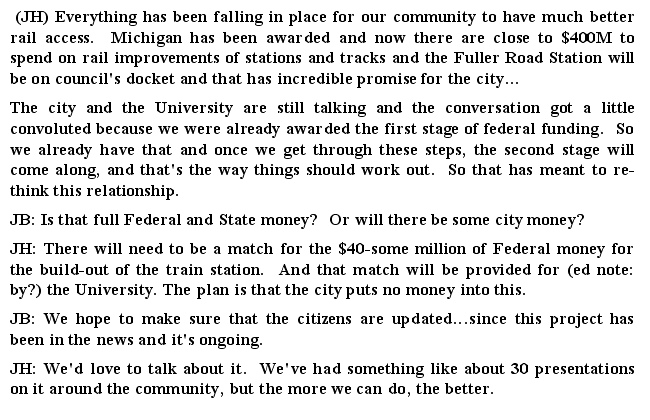
Now the man behind the curtain has spoken again.  The mayor was interviewed recently (November 23, 2011) on “Conversations”, a program on Ann Arbor’s Channel 19 (CTN) conducted by interviewer Jim Blow (see recording here).    Just one minute of that interview dealt with Fuller Road Station.  Some parts are difficult to hear, but a transcript has been made.  (The interviewer’s questions were abbreviated slightly.)

Here are the relevant statements from the Mayor’s comments.

So what was that again?  The Mayor seems to be conflating the original Phase I (parking structure) plan for the site with the future train station when he talks of the match for the $40 million for the train station.  The Fuller Road parking structure has been reported by AnnArbor.com as estimated at $40 million.  A more accurate figure is likely $46,550,000, as approved by the UM Regents in 2010.  That figure does not include site preparation of approximately $3 million, which, as the UM memo notes, is borne by the City of Ann Arbor.  (Ed. note: Presumably this includes the sewer work now underway.)  Although concept drawings include a location for a future train station adjacent to the parking structure,  what is being discussed currently is a parking structure, as we detailed in our post, Fuller Road Station: It’s All About Parking.

The UM memo also notes that UM agrees to pay 78% of the costs of construction of the parking structure, with the city picking up 22%;  this is consistent with the original Council Memorandum of Understanding .  The UM memo authorizes only a total “not to exceed” amount of $36,309,000 and also notes that the City will pay for an environmental assessment.  That means that in order to pay for its share of the parking structure, the city would need to come up with $10,241,000 (in addition to the cost of site preparation and the environmental assessment).  But how does that reconcile with the Mayor’s statement that “the plan is that the city puts no money into this”?  No wonder that, as he says, “the conversation got a little convoluted”.

Additional hints that the process has been drifting askew were provided by comments at a recent Ann Arbor Public Art Commission meeting where, according to the Ann Arbor Chronicle, AAPAC commissioners were told that the public art for Fuller Road was being put on hold because the project was delayed by “as much as 6-12 months”.  But in an interview by AnnArbor.com, the Mayor said that “two to three months sounds more reasonable to me”.  The difficulty, according to that article, is that UM and the city attorneys are negotiating on a “construction, operations and maintenance agreement for the first phase” (i.e., the parking structure).

But it seems from here that there are two outstanding difficulties:

  • The continued assertion on the part of the Mayor that we can move right ahead on the train station.
  • A lack of understanding about where the city’s portion ($10+ million) of the construction costs is coming from.

Rumor and speculation hold that the city is trying to persuade the UM to make a loan of the city’s portion, to be paid for from parking revenues.  This idea was brought up by the Mayor in his letter of last summer,  but there has never been confirmation from the UM that this would be satisfactory.

Will Uncle Sam Really Make Us a Gift of a Train Station?

A puzzle all along has been that the Mayor has seemed to possess a blithe faith that somehow money will materialize to pay for the final train station realization of the  FRS. (The “$40 – some million of Federal money for the build-out of the train station” does not currently exist.)   And he continually assures us that this will not be at the expense of Ann Arbor taxpayers. But his assurance appears to be built on a poor understanding of current transportation funding.

Much of the belief in the possibility of a future Fuller Road train station seems to be based on an award received recently as part of a Federal grant to support Michigan high-speed rail between Dearborn and Kalamazoo (the line to Chicago).   As stated in Congressman Dingell’s announcement,  “The… funding will allow Ann Arbor to begin engineering and environmental documentation required to design and construct a new intercity and high-speed rail station, drop-off areas, rail platform and other work, including track, switches and signals.”  The crucial words here are “begin…documentation”.  In other words, this is only a grant for planning, especially to complete a NEPA (National Environmental Policy Act) report, which is required for all projects seeking Federal funds.

In the announcement and description of the High-Speed Intercity Passenger Rail Program (HSIPR) grants, details are given about what source funds for each grant come from, and specifically what they are to pay for.     Here is what the money awarded for the Fuller Road Station (title: Individual Project – Preliminary Engineering / NEPA) is actually to pay for.

This project is for the completion of preliminary engineering and environmental documentation required to design and construct a new high-speed rail station in Ann Arbor, MI to serve the Chicago to Detroit high-speed rail line.

Apparently just the fact that a Federal grant was bestowed for this very limited purpose is taken as assurance that the entire amount will be forthcoming.  In an email, the city’s transportation program manager Eli Cooper said,

The fact the FRA has funded the preliminary engineering and environmental documentation is the strongest evidence we have to date regarding the federal commitment to the Ann Arbor Station project. …to apply for final design and construction funding we would need to have completed preliminary engineering to have the information required in the application….a long standing practice that once a federal investment is made in the preliminary phases of work, and the funded work is completed satisfactorily, future phase(s) are generally awarded funding when applications are submitted.

But that is an erroneous assumption, and a frighteningly naive one.  All Federal grants are not the same.  It’s the source that counts.

Where the Money Came From

In President Obama’s stimulus program, formally named the American Recovery and Reinvestment Act of 2009  (ARRA), high-speed rail systems were given a special priority. As explained in this post from the Midwest Interstate Passenger Rail Commission,  the money made available for our Michigan high-speed rail enhancements were not originally designated for Michigan at all, but were part of a large pot of money ($2.4 billion) refused by the State of Florida.  Of this, Michigan received a lucky $400 million.  Most of Michigan’s windfall was prudently invested in improving our rail corridor between Detroit and Chicago (our important Detroit-Chicago Amtrak service).  There were rail improvements in the West Detroit area (signals, repairs), repairs to track along the corridor, and the state was able to buy a section of the track that had been owned by Norfolk Southern.  The freight company had not been maintaining the tracks for passenger service and there were many delays.  The “donation” from Florida helped Michigan to make many repairs and adjustments that will really help this important passenger rail route.  Several train stations were also renovated or, in the case of Dearborn, reconstructed.

Here is how the grant allocation breaks down:

There are several important points here.

  • This was a one-time opportunity.  The stimulus program is over.  The rejection of a grant by Florida meant a windfall for Michigan.
  • The money for the Ann Arbor station was only for completion of a NEPA assessment.  It was not for any aspect of actual station construction, unlike the other grants to communities along the Detroit-Chicago line.
  • As Congressman Dingell warned in his September announcement celebrating the grant award, the High-Speed Rail program (HSIPR) was facing “recission” in the House of Representatives at the time.  This has become reality.  The President proposed $1 billion; the Senate proposed $100 million; the House agreed to $0.00 (and the House’s version prevailed).  (Summary of transportation bill amounts here.)  There is no more money in the program.
  • Even if we were to get a Federal grant to build a full station, such grants generally require a 20% matching contribution by a local entity.  For most transportation projects, that 20% of the total has been paid by the State of Michigan.  (And the state has paid the matching amount for the $2.8 million planning grant.)  Here Hieftje seems to be saying that matching money for the train station would be provided by the UM.  Is he hoping to count the money that UM is spending on the parking structure as a “match”?  If so, what is the statute of limitations on that?  Can we use money that UM spends next year to match a grant for a train station sometime in the indefinite future?

It seems that now, as before, we have more questions than answers.

UPDATE: As suggested by the first commenter, I erred by saying the $2.8 million was only for the NEPA assessment.  It was also for some preliminary engineering and planning work.  (But not for any construction.)  We’re still talking documentation.

SECOND UPDATE: The impact of Troy’s rejection of its $8 million grant is unknown.  News reports say that the money will be “reallocated” (a Chamber of Commerce spokesman was quoted in the Free Press article  as saying it would go to other states).

Historical note:  See the January 2010 article in the Ann Arbor Observer where Mayor Hieftje suggested that the value of the land might be credited toward the city’s cost of the Fuller Road Station.  That idea has been dropped, evidently.

THIRD UPDATE:  A press release that is undated but was made public on February 10, 2012 announces that the University of Michigan is pulling out of the agreement to build parking at the site of the Fuller Road Station. 

“After months of fruitful discussions, we received new information from the Federal Rail Administration regarding the eligibility of monies for the local match. This information altered project timing such that we could no longer finalize a proposal under the current Memorandum of Understanding,” said John Hieftje, Mayor of Ann Arbor.

Note: Posts about Fuller Road Station and other transportation topics are listed on our Transportation Page.