Archive for January 2013

Topsy-Turvy Transit: Where Do We Go From Here? III

January 1, 2013

Continuing a retrospective of AATA’s countywide transit authority efforts, with a look ahead.

In the first post of this series, we described AATA’s decision to “catapult” the authority into its hoped-for transition to a countywide service by advance implementation of several services.   This meant that AATA passed a deficit budget for FY 2012 (which began in October 2011).  At the time, it was clearly expected that this bold leap would be for one year only.  As we reported at the time, it was evident that the intention was to ask voters to approve a property tax millage in the November 2012 election.  Assuming that was approved, there would have been a funding gap between September 2012 (the last month of that fiscal year) and July 2013 (when taxes for the next year would be collected).  We commented,

But the AATA, which uses the Federal tax year (October-October), would have to pass a new budget in September 2012 in advance of the millage vote.  So not only will the AATA have to pass a new year’s budget without a certainty that a countywide millage will pass, but three-quarters of a year will pass before revenue will be realized from a successful millage vote.

And indeed, September 2012 rolled around and a new budget was passed.   As the Ann Arbor Chronicle reported,  the AATA finished the year with a deficit of over $1 million.  (Note: the deficit is the difference between revenues and expenses; this does not reflect a negative fund balance overall.)

And so the AATA began another fiscal year with a deficit budget (this time the projected deficit is about $300,000).  That was partly because of a reduction in state formula support, as detailed in an expanded report by the Ann Arbor Chronicle.  But they had a bigger problem: the possibility of new revenue had been pushed much farther out toward the horizon than anticipated.  Instead of a November millage vote, they were instead only now preparing to incorporate the Washtenaw Ride (that request to Washtenaw County would take place October 2) and after an opt-out window, would ask countywide voters to pass a property tax millage, perhaps in a May 2013 election.

From the Chronicle’s first brief account:

At the board’s Sept. 27 meeting, board treasurer David Nacht was keen to stress that various initiatives in which the AATA has invested in the past year and in this next year’s budget could not be sustained without the kind of additional funding that could come from a countywide authority.

Of course, just the next month, as we have described, most communities in the county opted out, and the “countywide authority” vanished into a puff of smoke.

What could go wrong?

Reprinted with permission by S. Harris.  Copyright by ScienceCartoonsPlus.com

Reprinted with permission by S. Harris. Copyright by ScienceCartoonsPlus.com

From the beginning, the AATA’s quest for a countywide (Act 196) authority has been powered by magical thinking.  A number of assumptions were made, one of which is that no obstacle was insurmountable. But really, if only one of these assumptions was in error, they were in trouble.  The other items of faith:

Local governments will opt in (didn’t happen).

Voters will support a new millage (irrelevant at this point).

Required documents (4-party, Articles of Incorporation) passed by City of Ann Arbor and Washtenaw County, along with the City of Ypsilanti quickly, for a November 2012 millage vote (final sign-off by the BOC in September, much too late).

Changes in Federal transit funding would not affect them negatively (see the memo by Chris White; loss of discretionary funds; still some uncertainly with the Federal budget sequestration).

But if not the greatest miscalculation, certainly a major one was the mis-estimation of the effect of Washtenaw County’s inclusion in the Regional Transit Authority for SE Michigan.  As explained here, a package of bills passed in the lame-duck session of the Michigan Legislature and has been signed into law by Governor Snyder.  This is a succinct summary of the main package.    (The detailed discussion of the effects of Washtenaw County’s inclusion will be in a later post.)   We speculated a year ago that then-Board Chair Jesse Bernstein expected that a vehicle license fee associated with this package might serve instead of a millage to fund the AATA’s expanded authority.  He had made some cryptic remarks, like this one at the October 2011 u196 meeting:

“Everyone talks about a millage, but I’m hoping that the Governor will light a candle over the weekend.”

Earlier, there was this exchange at the September 2011 Planning and Development Committee meeting (discussing the deficit budget later voted in by the Board):

Rich Robben: We won’t be able to follow this mechanism (dipping into reserves) next year.  We’d better pull some rabbits out of a hat.

Michael Ford: I’m looking at finding some rabbits.

How SB 910 would have allowed a county vehicle fee (from illustration by Richard Murphy)

How SB 910 would have allowed a county vehicle fee (from illustration by Richard Murphy)

All this became clear once the package of bills was revealed in January 2012.   SB 910 provided for any county to assess a vehicle license fee, upon passage of a measure by the county BOC and approval by the voters.  The bill provides for up to $1.80 per $1,000 vehicle list price to be assessed in addition to all other vehicle license fees, and paid to the county treasurer for transportation purposes.  However, if the county were in the RTA, the amount of the fee would be reduced by the fees paid to the RTA.

Right up to the issuance of the final 5-year plan, AATA staff apparently had hoped that this source of revenue might replace the need for a millage.  But the plan acknowledges that the millage appears to be the only option.

From the September 2012 final 5 year plan

From the September 2012 final 5 year plan

Proposed BRT routes into Detroit. Graphic by Dave Askins of the Ann Arbor Chronicle, used with permission.  Pointer is Detroit Metro Airport.

Proposed BRT routes into Detroit. Graphic by Dave Askins of the Ann Arbor Chronicle, used with permission. Pointer is Detroit Metro Airport.

The RTA package was delayed past the initiation of Washtenaw Ride, so the vehicle license fee did not materialize in time–or ever.  When the RTA package was finally passed in the last days of the 2012 lame-duck session, SB 910 was not included.  The only vehicle license fee included in the final package is that which will support the RTA itself, most likely to initiate Governor Snyder’s dream of Bus Rapid Transit connector routes.

So – after 18 months of intense effort, the AATA finds itself highly leveraged, over-extended, and with no immediate source of new revenue.  And in addition, it has an extra layer of complication introduced with the inclusion of Washtenaw County in SB 909, establishing the SE Michigan Regional Authority.

Next: What now?


Topsy-Turvy Transit: Where Do We Go From Here? II

January 1, 2013

In our previous post, we listed five assumptions that AATA was operating under in its quest for a countywide transit authority.

  1. The elected officials of all the units of government in Washtenaw County would assent to being included in a new scheme that included a likely new tax and a governance model that left Ann Arbor mostly in charge.
  2. Ann Arbor, the city of Ypsilanti, and Washtenaw County would all sign off on a couple of fairly substantial legal documents.
  3. The Regional Transit Authority for SE Michigan either would not materialize or would not affect them significantly.
  4. The voters across the county would vote in a new property tax, including in both tax-adverse rural townships and the voters of Ann Arbor and Ypsilanti, who were expected to add this millage to one already existing.
  5. Changes in Federal transportation funding would not affect them negatively.

From AATA’s perspective, assumption #1 seemed pretty reasonable to begin with.  From the beginning, staff spent many hours meeting with local officials and holding local public meetings.  They were  assisted by the Executive Director of the Washtenaw Area Transit Study (WATS), Terri Blackmore.  (Blackmore is more or less the godmother of the countywide transit plan and knew many of these officials through her professional activity.)  They received generally a good reception.  A number of local officials allowed the use of their faces in promotional materials and ultimately signed on to serve on the “u196 board”.  The u196 board, who were recruited via the district governance scheme, were all either local officials or very solid citizens who were accustomed to accepting civic responsibility.  Meetings began in November 2011 and the u196 appointees sat solemnly through a number of excellent staff overviews of various topics concerning transit.

u196 BOD
(Note that the list circulated at the second meeting does not include any representatives from Ann Arbor.  According to the governance scheme, the u196 board was to have 15 members, 7 of whom would be the current AATA board, representing Ann Arbor.  However, it was decided by leadership that the entire AATA board could not sit on the u196 board, since that would make meetings essentially a meeting of the AATA board and thus come under all the legal requirements of the Open Meetings Act.  Therefore, three AATA board members (the actual individuals who served changed) sat on the u196 board.)

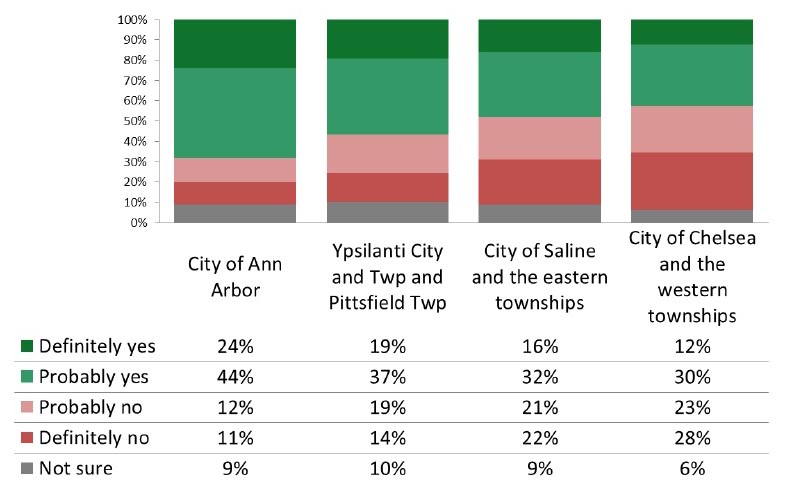
But the acquiescence of u196 board members to discussion was not a promise that the political environment at home in the township would be favorable to an agreement on new taxes.  As we detailed in this post about county politics, many townships have a long tradition of very low property tax millages, and a 1-mill tax would have been doubling tax rates for some townships, a very hard sell.  And AATA leadership ignored the results of their own survey data (results from March 2012).

Results by region: Would you vote for a 1 mill transit tax?

Results by region: Would you vote for a 1 mill transit tax?

Note that while 68% of respondents in the City of Ann Arbor said they would be likely to vote for a transit tax of 1 mill, and 56% of the urban core communities in Ypsilanti and Pittsfield were positive (combining “definitely” and “probably”), only 48% of those in the City of Saline and eastern townships, and 42% in Chelsea and western townships were positive.  Of those, the greatest proportion were only “probably”.  The overall percentages of respondents in 2011 who said they would be “definitely” vote for a tax was 18%, and 36% said “probably”, for a total of 54% positive responses.  But that overall positive number did not take willingness to participate on a regional basis into account. Further, was this really a very strong positive result, even overall?  Survey respondents are known to tailor responses to what they think the questioner wants to hear.  Who knows what that 36% of  “probable” voters would have done in the privacy of the ballot box?

Somewhat disastrously, AATA appeared to take the position that any negative implications were to be ignored or explained, and positive ones the only to be considered.  When six rural townships withdrew very early even from the planning exercises, AATA leaders like Jesse Bernstein began talking of population numbers and taxable value, in effect arguing that those townships didn’t matter.  But these withdrawals undercut the premise of a countywide authority and set a precedent for non-participation.

One move that AATA did make in the face of these negative indications was to reduce the target millage in an attempt to make a vote for a new tax more palatable.  As mentioned in the last post, the Financial Task Force was able to reduce the proposed millage amount to 0.5 mills by excluding a number of projects from the cost of the plan (though AATA kept them in the plan and continued to spend money on them).  But there was again a political miscalculation here.  It was not a matter of the amount of the millage.  It was the question of any new tax at all for the benefit being offered.

Remaining (green) and opted-out (red screen) communities in Washtenaw County as of October 30, 2012.  Dexter Village had not voted.

Remaining (green) and opted-out (red screen) communities in Washtenaw County as of October 30, 2012. Dexter Village had not voted.

Ultimately, AATA simply failed to make the sale.  As we attempted to explain in an earlier post, for most sections of the county, the plan didn’t pencil out.  Once AATA sent out letters to municipalities offering a 30-day window from October 3 for opting out (the date was later extended to December 10), there was a rush to the exits.  By October 30, all but four governmental units had formally opted out.

Faced with the likelihood that the new authority was likely to consist of Ann Arbor subsidizing transit for a couple of other nearby communities, the Ann Arbor City Council voted on November 8 to opt out of the Washtenaw Ride and also to cancel the city’s participation in the 4-party agreement.

With Ann Arbor out, remaining communities followed suit.  Dexter Village finally opted out, and Ypsilanti Township and the City of Saline reversed their earlier “opt-ins”.  (See our post,  Washtenaw County Transit – More Outs than Ins for a blow-by-blow account.)

Opt-outs as of December 5. Only Ypsilanti City remains.

Opt-outs as of December 5. Only Ypsilanti City remains.

By the deadline of December 10, only the City of Ypsilanti remained in the Washtenaw Ride.  As reported by the Ann Arbor Chronicle, the November 18 AATA Board meeting sought to put the best face on what was, in fact, a devastating rejection of their efforts to put together a countywide transit organization.

Next: It’s all about the money.