Archive for March 2012

Fairness and Transit III

March 13, 2012

Is the proposed “countywide” transit funding scheme fair to Ann Arbor?

First, let’s review what the new plan will cost Ann Arbor taxpayers. The Financial Task Force appointed by the AATA to come up with a funding plan were able to reduce the likely millage needed to 0.5 mills (based on full countywide participation). Here are their budget spreadsheets for the first 5 years of the plan: the operating budget, the capital budget,and the summary.  (Their full report and service review subgroup report have some explanations of changes and assumptions.)  After excluding some capital-intensive projects and making some other adjustments, they were able to project that the plan could be done with a 5-year budget gap of $32,877,825; that is, nearly $33 million in new funding must be found to pay for the reduced plan.

An important assumption in the FTF’s budget is that the Transit Master Plan’s services will be extended to the entire county, and the new funding (we still assume that this is a property tax millage, though they took care to deny that this is their recommendation) could be paid by a 0.5 mill tax on the entire county tax base. This appears to be substantially correct. Using their assumptions (no change from 2011, no subtractions for DDAs and other TIF, no change in law to exclude personal property), the 5-year yield from a whole-county 0.5 mill tax would be $32,788,601.  (Here is a spreadsheet summarizing all the TV and millage yields.) (Note: the FTF calculations and all those here are based on the Washtenaw County taxable values table for 2011.  The taxable values for 2012 will not be available until assessments are fully reviewed and apportioned.  This should be any day now.  See our post on city income tax for a discussion of the assessment and tax schedule.)

Washtenaw County participating municipalities shown in green; five townships have declined. Click for larger image.

But as we already know, the full county will not be participating.  According to the response I obtained through a FOIA, 5 of 20 townships have already declined to participate.  If these low-population rural townships’ taxable value is subtracted, there is still a calculated 5-year tax yield of $30,968,566.

Terri Blackmore, the executive director of Washtenaw Area Transportation Study (WATS) has been somewhat the godmother of the countywide transit plan, including its governance structure.  At the FTF meeting, she rose to point out that as municipalities drop out, so will the service to those areas, reducing expenses.  However, on examination, it is clear that these townships would not receive much additional service in any event.  They may have been able to expect more demand services, and to make use of express services by traveling to a city or township nearby.  Eliminating those services to these few residents will not be likely to bring about $2 million in savings.

The “optimistic” scenario (click for larger)

In our earlier post, How Much “County” in Washtenaw County-wide Transit?, we presented a number of different scenarios for participation across the county, each with justification.  Let’s assume for the moment that the “optimistic” scenario is the correct one.  Note that this scenario retains all the cities (except Milan), the more urbanized townships, and several more distant townships that have reason to be more amenable to a regional plan.  They represent the greatest fraction (with the city of Ann Arbor) of the taxable value of the county.  Still, the 5-year total is still only $26,912,443 – a $5-6 million shortfall of the amount needed.  The townships who have dropped out are still not heavily served by the TMP, so again the savings are not likely to be high.

But Ann Arbor (and the city of Ypsilanti) are still contributing the full amount of their charter millages, so as other communities in the county drop out, the total tax contribution of those two cities rises in proportion to the rest of the county.  This effect is exacerbated by the drop in the new millage from 1 mill to 0.5 mills.  And since (under what is actually a set of very generous assumptions) there is already a “budget gap” again, the burden is likely to fall on the remaining communities disproportionately, since they will have to carry the truly regional aspects of the TMP with less support.  This will inevitably lead to more fare increases, loss of service, or perhaps additional tax demands.

Percent tax paid in a single year by Washtenaw County communities (the “optimistic” scenario), based on 2011 TV and 0.5 mill new millage. Ann Arbor and Ypsilanti millage rates based on FTF assumptions.

So taxpayers of the city of Ann Arbor (who make up almost exactly 1/3 of the population of the county: 113,934 vs 334,791; thanks to Steve Bean for challenging me to make this comparison) are expected to pay more than twice that relative percentage in property taxes in order to support a “county-wide” transit system.  If you own a house that has a TV of $100,000 (which means that it has a supposed market value of $200,000, depending on what year you bought it), you will be paying $250 each year to support the new transit system.

Is that fair?

In the next post we’ll explore what fairness, and its cousin, equity, mean in this context.

UPDATE:  For a full apples-to-apples comparison, here are the amounts and percentages of tax paid in one year by all currently participating communities.

Tax paid by all participating communities (including 15 townships and all cities and villages), assuming a 0.5 mill tax plus existing charter millages. (2011 valuations)

Assuming that all communities currently participating in the u196 process also remain in a new authority,  94.5% of the taxable value of the county will be included in the new tax.  However,  the City of Ann Arbor represents 35.7% of that TV, and because Ann Arbor will be paying tax at a rate Five Times that of all communities other than the City of Ypsilanti, its tax contribution to the new transit authority is still nearly three-quarters of the total.

UPDATE: Northfield Township has now withdrawn from the Act 7/u196 organization. This means that the “optimistic scenario” above was in indeed optimistic.  Six of the twenty townships in the county are now out of the picture – and the formal decision hasn’t even come to them yet.

Fairness and Transit II

March 10, 2012

Is the countywide transit plan fair? (The sequel)

In our previous post, we introduced the idea that a major underlying factor in discussion of the countywide plan (an umbrella term that includes the TMP and the proposal to incorporate a new transit authority: see this post for a discussion of the differences) is the concept of fairness.  So much of the back-and-forth has been about the question of who will pay vs. who benefits, and how fair that is.

Let’s review the proposition briefly.

  • The idea is that the current Act 55 Ann Arbor city transit authority (AATA) will eventually be disbanded and its assets (both hard capital assets like buses and shelters, and financial reserves) will be turned over to a new Act 196 authority (currently being called the New Transit Authority) that has a broader potential geographic reach.  See our post, AATA: Moving Us Along for some description of the process.
  •  But to give the new authority a solid revenue base, Ann Arbor’s perpetual millage (voted into the city charter by the citizens and thus sometimes called the “charter millage”) is proposed to be transferred to the new entity.
  • The City of Ypsilanti, which also has a charter millage, would do the same.
  • This transfer of charter millages to the NTA is the only purpose of the 4-party agreement, approved as amended (pdf of draft, as amended, that was approved) by the Ann Arbor City Council, March 5, 2012.  (See brief report from the Ann Arbor Chronicle here.)
  •  The NTA would also levy a millage across the entire county (or the parts that didn’t opt out of it) to support additional services.
  • Depending on the level of that millage (both 1 mill and 1/2 mill have been discussed), it has been acknowledged that taxpayers of Ann Arbor will pay the greatest share, perhaps about 2/3, of the entire local tax collected to support the Transit Master Plan, which is also referred to as the “county-wide plan”.

Some basic questions

  1. Is it fair if taxpayers in rural communities (the “countywide” in the table below) who will receive some, but not much, increased service, pay for an enhanced system with some strong urban biases?
  2. Is the proposed arrangement fair for the communities other than Ann Arbor who are part of the urban network?
  3. Is it fair if Ann Arbor taxpayers pay most of the cost of a county-wide system?

 The “countywide” rural communities

As we discussed in a couple of former posts about politics of a millage vote and the likelihood that various local units might drop out of a “countywide” organization (5 townships out of 20 have already declined to participate), the history and politics of the other communities in Washtenaw County is that they are very resistant to voting for increased taxation, since even half a mill is a substantial fraction of their current taxes.

  • The actual service improvements being offered to many of the more rural townships are minimal. In most cases, only a commuter express bus is being proposed for the outlying areas. Express buses do not serve the needs of individuals who are not mostly commuting to a job in Ann Arbor. Hours are restricted and “demand” service (for the disabled and elderly) does not automatically go along with express bus service. (With a fixed bus route, Federal rules require demand service at no more than twice the fare for a fixed route, but that requirement can be evaded with express buses.)

The Transit Master Plan overview, as prepared by consultants Steer Davies Gleave. Click for larger view.

  • Note in the table below that only about 10% of operating costs are proposed for bus service and demand service outside the urban area. (The “urban network” is roughly described by the green blob with yellow lines in it above.)
  • Also, a significant percentage of the long-term expense is for high-capital projects like commuter rail, which doesn’t directly benefit those more distant communities.  (Note that commuter rail, the airport service, and the long-distance express bus services could be said to enhance the economics of the entire area, so might be argued to have a diffuse but real benefit to rural communities.)

Summary of combined operating costs for different types of service, from Financial Task Force November 2011 distributions

The non-Ann Arbor communities that are part of the urban network

Some communities are currently paying for AATA (fixed route bus) services, under what is called POSA (Purchase of Service Agreement).  Those POSA would be revoked under the Act 196 NTA, since those communities would be part of the new transit regional authority.

The City of Ypsilanti has a dedicated millage for transit of approximately 1 mill.  Actually, that millage does not go directly to AATA as tax receipts.  Instead, it is used to pay the POSA for the service that Ypsilanti has had in the past. (See the route map.) Originally, there was no money to pay for this service in Ypsilanti’s increasingly stressed city budget.  For a while the cost was borne by Federal stimulus funds.  Then, the citizens of Ypsilanti voted in the charter millage (a really brave and forward-looking act on their parts).  Recently, because of changes in the AATA chargeback schedule, the millage amount fell short of the required amount to pay the POSA, causing consternation in Ypsilanti’s City Council.  But the service has not been curtailed, and even better, recently service on Route 4 has been increased at no additional cost to Ypsilanti (the amount not covered by Federal formula funds is paid by Ann Arbor taxpayers).  Still, the on-and-off-again bus funding has led Ypsilanti’s mayor Paul Schreiber to support the 4-party plan at a public hearing in Ann Arbor “to stabilize Ypsilanti’s bus service”.

Now that the City of Ann Arbor has (provisionally) approved the 4-party agreement, the baton passes to the City of Ypsilanti.  My information is that it (the agreement) is on the March 20 council agenda.

The City of Ypsilanti’s budget problems are simply staggering.  For an overview, see Mark Maynard’s discussion of the consequences of the nonapproval of a city income tax.  On May 8, Ypsilanti’s beleaguered taxpayers will be asked to approve both a 1% income tax (0.5% for workers in Ypsilanti who live elsewhere) and an additional millage to pay off debts.  Ypsilanti’s property tax millage is already the highest in the county (for 2011, it was 33.6731, over twice the City of Ann Arbor’s at 16.4660 and miles above any township).  In spite of this, the city has gone through round after round of service cuts.  One problem was an ill-advised attempt by the city to dabble in development.  The Water Street Development, a failed exercise in urban redevelopment, left the city with bond debt and unaffordable payments.  So on May 8, in addition to the income tax vote, residents are being asked to vote themselves an additional 4.7085 mills merely to retire these bonds.  (The Ypsilanti City Council is now expecting that they will not need to levy the full amount.)

To POSA or not to POSA?

Ypsilanti City and three other Washtenaw County municipalities currently pay POSA (purchase of service agreement) contractual amounts to AATA for specified services.  They are all within that urban network seen in the map above.  POSA charges are calculated yearly using a formula to pay actual “loaded” costs of the specified services.  In general, POSA amounts are part of a municipality’s general fund budget and are paid right off the top of their discretionary revenue.

Here are the amounts these communities currently pay in POSA charges, and the total tax that would be raised if the countywide millage were applied instead.  Note that the POSA charges would disappear.

*Amounts for Ypsilanti City are calculated differently. Its tax rate would include the current 1 mill plus the additional countywide millage.

As is quickly evident, the total tax dollars paid by each municipality would be considerably higher with the new transit plan.  The difference for all but Ypsilanti City is that the municipal budgets would save money and the costs would be transferred to their taxpayers.  Because Ypsilanti City would be a signatory to the 4-party plan, while the accounting method would change (a direct transfer of their millage to the NTA rather than a check), their taxpayers would continue to pay the current millage amount plus the additional millage.

This might not seem too bad a deal for Ypsilanti City, considering that they are already receiving enhanced service without paying for it and there are many of the other enhancements to the urban network will serve them directly.  But whether their anguished taxpayers will agree with this as they face two more impending tax measures is a different question.

For the other municipalities, it does not appear that they will immediately see markedly different service levels.  The current routes that are being supplied with fixed-route buses may see some hour and frequency enhancements, and more Park and Ride lots and transit hubs might be built.  But new fixed route lines look to be unlikely in the near future, based on the maps that have been provided.  Thus, whether taxpayers from Superior, Ypsilanti and Pittsfield townships view the change as “fair” probably depends in part on whether they view the general increase in connectivity over the county to be beneficial to the overall economic climate and thus to themselves.

Complications to the who pays, who benefits question

All the discussion so far as been based on the assumption that the voters of the county will vote in a new millage to support a new transit authority.  The talk for the last several years was that it would be 1 mill.  However, this has now been scaled back to 0.5 mill.The recommendations of the Financial Task Force, issued on February 29, are just that, recommendations.  The FTF has no actual authority and is not the final planning body for the new authority, which does not yet exist.  Thus, its projections are merely hypothetical.  Nevertheless, they were able to arrive at the 0.5 mill amount (which they style as a mere placeholder, not an actual recommendation for a millage) by stating that the capital-intensive commuter rail and connector programs should not be folded in to the 5-year plan (thus allowing a smaller budget gap to be addressed by a millage).

This recommendation is apparently being sidestepped by AATA.  As its CEO Michael Ford says in his executive summary for March 15,

Capital intensive portions of the original program were removed with the caveat that alternate sources of funding should be secured to support the service.However, the planning and development of the capital projects will continue, but will not be slated to utilize the new local funding source.

Now this is a puzzling statement.  Money is fungible and if an activity costs something, it comes out of the total budget.  So if the FTF considered the total budget and recommended the exclusion of activities that are being carried out anyway, the money has to come from somewhere.  AATA has, of course, had budgets for many years in which certain funds (like Federal formula funds) had to be allocated to specific services.  But it is dizzying to consider an accounting system that somehow segregates general tax funds in such a ways that one dollar goes to allowable uses and another is held back.  The sleight of hand is less impressive when the quarter falls out of the cuff.

The inescapable conclusion is that the additional millage paid by former POSA communities will, in part, be used for commuter rail and connector projects.  (Though these might depend heavily on Federal and private funding, they will require some local funds.)

Another factor in the calculation of benefit vs. additional payment is that the FTF also recommended (in order to make this package fit into its tighter garment) that fares be raised an average 50 cents.  So while the former POSA communities are paying more in property taxes, their transit riders will also be paying more to ride.

Is that fair?

Next: the conclusion.  Is this plan fair to Ann Arbor?

UPDATE:  The final version of the 4-party agreement as passed by Council on March 5 is here.

SECOND UPDATE: Note the comment regarding the meaning of the 4-party agreement below.  There is additional justification for my statement that the 4-party agreement is necessary only because of the transfer of the two city millages.

THIRD UPDATE: A commenter also raised the issue of availability of demand (“paratransit”) services. Though the Financial Task Force recommendations themselves make no reference to lowered expectations for these services (apart from a fare increase), the report from the subcommittee signaled that they may be regarded as optional, depending on funding.  The quote is from their presentation on February 29, 2012.

“Adjustments to estimated Countywide Door-to-Door service costs – reduced estimated usage volume based on A-Ride’s experience with the proportion of eligible population that are active users.”

Fairness and Transit: Where AATA Is Moving Us

March 1, 2012

Is the countywide transit plan fair?

Underlying many of the debates about the “transit transition” – whether we should move to a new type of  “countywide” transit authority – is a question of fairness. For most government programs some people will always pay more than they receive in benefits and others will receive them while paying almost nothing. We have generally accepted that in order for society to work, we must pool our resources and distribute them on the basis of need.   But we hate it when that isn’t done fairly.

Because of the tax revolt that started in the 1970s and most recently with the rise of the Tea Party, this question of fairness in taxation vs. benefits is a constant source of friction among us.  Many people now think that they should receive a direct benefit from paying taxes, in a payment for services rendered model.  This has a lot of problems, including that it is sometimes hard to recognize the benefit.  A thought-provoking recent article in the New York Times revealed that some of the people (and the states) that have become most vehemently opposed to taxation and to government benefits are the ones who most benefit from those programs.  As the article says, “Many people say they are angry because the government is wasting money and giving money to people who do not deserve it.”, yet those who consider themselves middle class are increasingly dependent on government programs.  Paul Krugman reflected on this in an excellent column and pointed out another study that “points out that many beneficiaries of government programs seem confused about their own place in the system… that 44 percent of Social Security recipients, 43 percent of those receiving unemployment benefits, and 40 percent of those on Medicare say that they ‘have not used a government program.'”  He concludes, “Presumably, then, voters imagine that pledges to slash government spending mean cutting programs for the idle poor, not things they themselves count on.”

The need for fairness is apparently built into our very nature.  A great deal of research with both animals and humans indicates that we are “hard-wired” to a sense of fairness.  So while children can readily be socialized (and may not require much) to share their cookies, they will protest loudly if they are required to give them all away.   This is an example of distributive justice and we feel it on behalf of others as well as ourselves.  It is reflected in actual brain activity and some studies have shown that aggressive behavior can result if actions are perceived as unfair to the group.

One way this is often expressed is the concept of “social equity”.  Except for those serious tax-haters, most people still recognize that we should, in effect, redistribute resources (wonkspeak for “money”) from those who can afford to pay to those who have less but who still have human needs that we recognize as a societal responsibility.  I’ll share my cookies with you rather than see you go hungry.  But note that concept of the “deserving poor”.  If you eat my cookies and then pull a candy bar out of your back pocket which you eat in front of me without sharing, I’m going to be angry.  Many people are suspicious that others are in essence doing this, taking benefits and then using their own resources for private purposes rather than paying their own way.  “Paying your own way” can either mean that you put just a small contribution into the common pool, or that you carry out some obligation that you have accepted as a condition of receiving the benefit.  An example would be that you use a scholarship to obtain a degree and become a productive worker, rather than spending it all on beer and pizza.

Regions used for the survey (click for larger map)

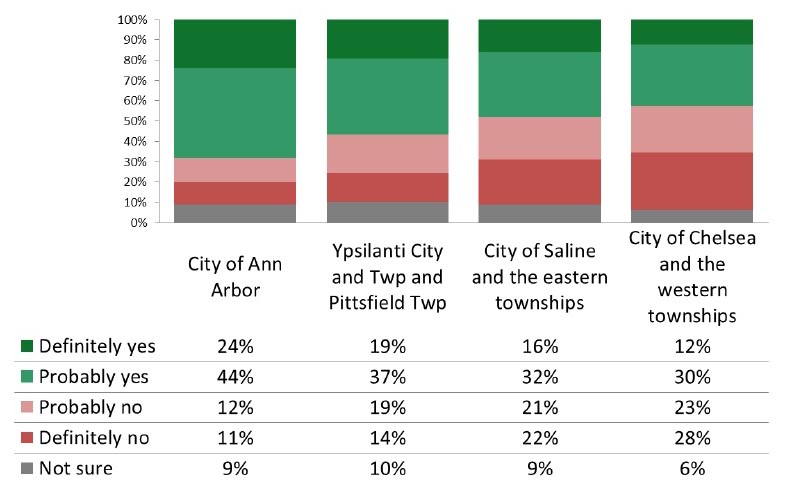
AATA has endeavored over the last several years to start a broad public discussion about public transit, how it is used, what its importance is, how desirable it might be.   There have been endless public meetings, press releases, and educational materials about their Transit Master Plan.  (See Moving You Forward for history and the TMP reports.)  There have also been surveys to gauge public response, and the latest has finally been released.  The Ann Arbor Chronicle’s account is probably the most accessible way to review the results.  (The full set of presentation slides is here.)  It is clear that public acceptance of transit is very high.  Almost all the respondents (91%) said that transit was important, and the AATA itself got a positive rating from 89%.  But once the subject of how this will be paid for was raised,  approval became more fractured. The overall response to the question,  “would you be likely to vote for a 1-mill tax to support an expanded program?” was 59% (after some discussion of the issue); but this was strongly influenced by geography.

The survey was taken in four geographic regions (the full report that discusses actual distribution of samples has not yet been released), and the results differed by region.  While 68% of Ann Arbor residents said that they definitely or probably would vote for a millage, 56% of Ypsilanti and Pittsfield residents, 48% of Saline and eastern townships, and only 42% of the western townships, including the city of Chelsea, gave this positive answer. (Click to see a full-size chart.)

The telling reasons behind reluctance to vote for a millage even when approval of the idea of transit is so high are (quoting from the Chronicle):

They were asked about the idea that it’s unfair for everyone in the county to pay for a tax that mostly benefits Ann Arbor and Ypsilanti. And they were asked about the idea that it’s unfair for people in Ann Arbor and Ypsilanti to pay more than others for transit benefiting everyone. A roughly equal number of people agreed or strongly agreed with each of those sentiments (32% and 30%).

In other words, the underlying question in many minds is really a question of fairness.

Next: evaluating the question of fairness in the transit transition.

Note:  Other posts in this series are listed on the Transportation Page.

UPDATE: The final report on the survey is here.
Like any 97-page report, it will take time and study to analyze, but it gives an interesting insight into the difficulty of conducting a proper survey (sampling controlled, etc.) under the current conditions in which many people, especially younger ones, no longer have landline telephones that are listed in public directories.