Archive for January 2012

Following the Money for (Washtenaw) County-wide Transit

January 29, 2012

In our previous post, How Much “County” in Washtenaw County-wide Transit, we examined the likelihood of full countywide participation in the New Transit Authority (Act 196 authority) and the Transit Master Plan.  Our conclusion was that it is not likely to happen.  (After all, somewhere between four to five townships have already opted out even of participating in preliminary talks.)  We presented several scenarios and calculated how much revenue a 1-mill tax could produce in each case.

The Financial Task Force appointed by the AATA board to review finances for a future countywide authority was supposed to produce in January 2012  a “white paper” explaining how the ambitious TMP would be funded.    But they were disrupted in their orderly progress toward this goal by Governor Snyder’s introduction of new transportation proposals (see the Ann Arbor Chronicle’s account).  In the light of the uncertainty introduced by a proposal for a four-county Regional Transportation Authority and new vehicle fees that might fund transit to replace the use of property tax millages, the FTF instead created a subcommittee to do some heavy lifting on “uses” (namely, what programs would actually be included in the TMP, with part of the consideration as how well they would pay their own way).  Again, the Chronicle has captured the work of that committee very well.  I must say that the group was very impressive in their ability to read spreadsheets quickly and pick out the substantive questions, identify issues to be resolved, and move quickly toward a set of recommendations.

Having produced their recommendations, the subcommittee was prepared to present them for discussion by the full group on January 27, 2012.  But the day before that meeting, the long-awaited package of transportation bills, including actions that could have major consequences for a Washtenaw County transit authority, finally was introduced into Michigan’s legislature.  (Please consult the overview of the package as described by the Ann Arbor Chronicle.)  At 11:45 a.m., a message went out that the 2:30 p.m. meeting had been postponed in order for the FTF to assimilate all this new information.

But even though the FTF is temporarily on hold, the materials prepared for their meeting are informative.  Several conclusions and observations can be drawn from them.

1.  The original estimate of a  “budget gap”  was $60 million over the first five years of the plan.  The subcommittee was able to bring it down to a little over half that.  A major part of this accomplishment was due to simply “zeroing out” some services.  The Downtown Circulator (also known in a previous incarnation as “The Link”, received little respect at committee meetings and was left to private funding.  The expensive rail and connector services were put aside as deserving a different form of consideration and financing, in essence removing them from the “countywide” plan for the time being.  The chart below shows operating expenses for 5 years; the last two columns are averages, the very last column a “rounded” average.  (Note the figures in red at lower right-hand corner, denoting an operating deficit of about $20.12 million.)

5-year operating expense projection. (click for larger)

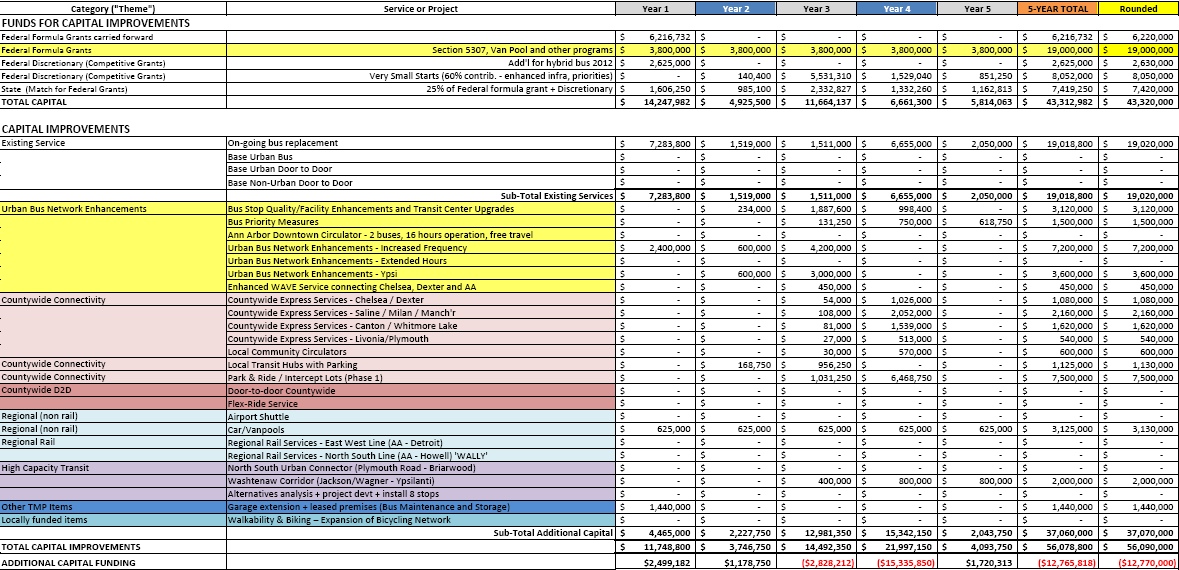
2. The capital expenses for the 5 years are about $56 million, but it is anticipated that most of these will be picked up by Federal and state formula funds and discretionary grants.  Note that this estimate does not include commuter rail expenses, but does indicate a capital investment for the Washtenaw connector.   Even after grants, though, a $12.7 million balance remains to be picked up by local funding.  (Click to see a larger image.)

Capital expenses. Deficit is shown in red at the lower right.

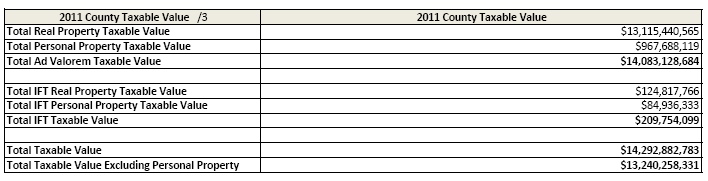
3. The subcommittee was able to estimate that a millage of only 0.3 mills could fund operation of the plan, and an additional 0.2 mills could fund the local capital requirements.  But they are assuming that the millage includes a property tax over the entire county.  Here are the property values on which the 0.5 mills value is based.  They are based on the same Washtenaw County Taxable values table that we used for our previous post.  A separate estimate of TV excluding tax on personal property (given that the Governor is proposing to exclude that) is made, but both values yield a millage rate of 0.5 mills.  (Click on the image for a larger view.)

4. In addition to eliminating some services from this estimate, the committee recommended an across-the-board fare increase of $0.50.  One practical effect of this is that Ann Arbor and Ypsilanti taxpayers, in addition to paying an additional 0.5 mills in taxes, would see the cost of riding the bus go up.  They also sensibly recommended an increase in express bus fares.

Not resolved: the subsidy by Washtenaw County taxpayers for express services to Canton and Livonia, communities that do not pay a POSA and would not be contributing tax money.

In conclusion, even before the Financial Task Force – and the transit riders of Washtenaw County – learn how the changes in state transportation funding will affect us here, the question remains:  how can we have a county-wide transit system if much of the county does not participate?

(Note: posts relating to this topic can be found on the Transportation Page.)

UPDATE:  The FTF met today (February 29) and has now widely distributed their reports.  The basic calculations and conclusions appear to be the same, but the group emphasized that the 0.5 mill figure is only “a placeholder” and “is not a recommendation for a millage”, that is, another form of funding may be chosen.  This was after a verbal summary of the very little that is actually known about possible state finance measures for transit, including a vehicle “ad valorem fee”.  The discussion of the situation in the state legislature (the legislation is still in committee) left up in the air whether a future Regional Transit Authority would intercept the monetary flow from Federal formula funding.  The final conclusion was that there were too many uncertainties to make final firm recommendations, but the group expressed support for the continuance of the TMP process and the goal of countywide transit.  See the overview of regional transit bills by the Ann Arbor Chronicle.  House Bill 5309 is the one that would authorize the Regional Transit Authority for a four-county region in SE Michigan.

How Much “County” in Washtenaw County-wide Transit?

January 27, 2012

Councilmember Christopher Taylor, who never hesitates to be lawyerly. He began reading pre-agreed amendments.

The Ann Arbor City Council patiently (and apparently attentively) listened to the public (according to AnnArbor.com, nearly 40 of us spoke) in another consideration of the 4-party agreement (link to marked-up version available before the meeting) on January 23, 2012.  While Mayor John Hieftje commented before the hearing that he was in “no hurry” to approve the agreement, the Council postponed its (possibly final) consideration only until the next meeting,  February 6.  In a clearly programmed step, all the amendments in the previously circulated version were approved, with CM Christopher Taylor taking the lead. A significant amendment specifies that “the articles of incorporation in the form presented for approval by the County shall be separately adopted by Ann Arbor and Ypsilanti by affirmative vote of the respective governing bodies“.  CM Taylor dismissed that as “discretionary,” not a requirement.  CM Sabra Briere gently and humorously rebuked (and rebutted) him, saying that she had looked it up and the use of “shall” means “has a duty,” thus this is not an optional requirement.  Taylor then stated that because of the “condition of precedent,” it was a subordinate clause–provoking a response from Briere that “I love that condition of precedent” (but she stood her ground that it is a requirement).  Mayor Hieftje ended this exchange with a quip, “Glad to see you’re on the same page.”

But the main action of the night belonged to the public, who expressed many views and raised many points, for, against, or simply qualifying the proposed agreement.  What almost all of them had in common is that they referred to it as supporting a “county-wide transit plan”.  Indeed, “county-wide transit” has been the shorthand way to refer to the Transit Master Plan from the beginning (the website for Moving You Forward speaks of “going countywide”).  But just how county-wide is it?

Mapping It Out

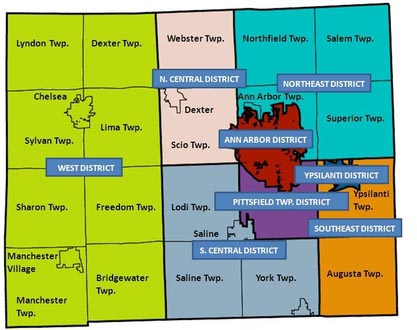
AATA’s map showing districts for the Act 196 authority

As we detailed in our post AATA: Moving Us Where? The Big Picture, the process toward “County-wide” began by signing up all the municipalities outside of Ann Arbor and the City of Ypsilanti  to Act 7 (Urban Cooperation Act) “interlocal” agreements. This produced a district arrangement based on population and also monetary contribution (Ann Arbor and Ypsilanti get more representatives because of their millages).

Note that Washtenaw County has 20 townships, and is usually said to have 26 municipalities.  Taking Dexter (village, soon to be city), Manchester (village), and the cities of Ypsilanti, Chelsea, Saline, and Milan into account, this only works if you don’t count Barton Village, or the city of Ann Arbor either.

But of the 20 townships, 4 (or is it 5?) declined to participate in the Act 7 agreements, thus have not been included in the “u196 board” of tentative representatives from the various districts.

There is some confusion about just which townships have declined to participate.  Though both we and the Ann Arbor Chronicle reported last fall that the abstainers were Lyndon, Sylvan, Bridgewater, and Salem Townships,  more recently AATA staff and a map used to illustrate districts have indicated that Lyndon is in and Saline Township is out.

The area of Washtenaw County that would be included in a countywide plan assuming no more opt-outs (click for larger)

The area of the county that would be covered, assuming that these townships also opt out of the New Authority once Articles of Incorporation are filed, is thus somewhat less than a full county’s worth.  But using the 2011 taxable valuations (TV) as estimates of how much could theoretically be collected by a “countywide” millage using only this participation,  it could still yield enough to pay the additional $60 million that was identified as the  five years’ budget gap, as the combined  TV would yield $12,387,427 per year (with a 1-mill levy).  (Note that all estimates include an additional 1-mill tax from the cities of Ann Arbor and Ypsilanti, but do not include their current charter millages.)

The “optimistic” scenario with rural townships removed

But how realistic is it to suppose that there will be no more opt-outs?  As we detailed in our post, AATA: Moving Us Where? The Politics, many of the small rural townships are very tax-averse and some have trouble even passing millages for police protection.   It seems very likely that they will, when faced with an actual possibility of being asked to contribute additional property tax, opt out.  CM Stephen Kunselman, in speaking to the Board of Commissioners, pointed out that these low-population townships could fear that the greater population of Ann Arbor and Ypsilanti would approve a tax even if they voted against it, thus would be likely to pull out.  As reported by the Ann Arbor Chronicle at that same meeting,  Commissioner Alicia Ping stated that except for “one mayor and one township supervisor”, there was no interest in her Southwest Washtenaw county district in joining the authority.  In what I have called an “optimistic” scenario, Manchester Township (with its village) and Dexter Township (a progressive township influenced by both the city of Chelsea and Dexter Village), remain in, as do populous townships like Pittsfield and Ypsilanti.  Superior has an urban population in its southern portion and Northfield is somewhat urbanized, with its own DDA. Scio has urbanized areas and would benefit from better transit into neighboring Ann Arbor.   Most cities and villages (other than Milan, at the edge of the county and half in a different county) are included.  The TV of these combined communities, though they represent the greater share of taxpaying property in the county,  a one-mill tax would yield only $10,764,977.

The “pessimistic” scenario

But suppose that this optimism is unfounded and only the townships in the immediate urban and urbanizing area (plus the major cities) remain in the authority’s area?  Scio Township in particular has succeeded in keeping its tax rate very low and discontinued its POSA that provided a minimal bus service along Jackson Avenue (an event poignantly captured by Julie Steiner of the Washtenaw Housing Alliance, who described mothers forced to walk for miles in the snow carrying their infants after the bus service to the Alpha House family shelter on Jackson was discontinued.)   Scio and the remainder of the western townships might well pull out (Manchester Village and Dexter Village would likely have to go along with the townships in which they are embedded), leaving only the cities and the remainder of urbanizing townships.  But Ypsilanti Township is under financial stress.  Though many of their residents are low-income, much of the population is rather diffuse and it could well be that the benefits of increased transit availability would not prove to be a sufficient incentive to expose themselves to a further tax increase (they’ve had to go to their voters for several lately).  This would lead to a millage yield of only $8,059,123.

A possible “minimal” scenario for the 196 transit authority

Yet even this pessimistic scenario may not be realized.  There could be a contagion effect (township leaders talk with each other on a regular basis) so that only Pittsfield Township (which has a large POSA currently and is well integrated into the bus system), and the cities of Saline and Ypsilanti join the city of Ann Arbor in the authority.  Saline’s mayor, Gretchen Driskell,  has been strongly supportive of the plan and Ypsilanti’s mayor, Paul Schreiber, appeared at the public hearing to say that the plan would “stabilize” Ypsilanti’s bus service.  Ann Arbor Township is not currently served by bus service (and does not contribute to the recent extension into its area for UM medical facilities).  The Village of Barton Hills, a wealthy enclave without public roads, would likely lobby strongly about being exposed to an additional tax.  So it is entirely possible that a newly formed 196 authority would be composed of only 4 municipalities, including the city of Ann Arbor.  Under this “minimal” scenario, only $6,606,568 would be raised from a 1-mill tax, half of what is needed to make up a $12 million annual budget gap.  Of that amount, two-thirds ($4,422,578) would be the new tax paid from Ann Arbor (separate from the existing $9 million collected already).

The Power of Prediction

Responses to question in 2009 “would you vote for such a tax?”

Obviously, these predictions (really, guesses) will be emphatically rejected by proponents of “countywide transit”.  But how could we determine which scenario is most likely?  One way would be to conduct a survey.  Ah, yes – there was a county survey done in 2009.  According to the executive summary of that survey, support for a new tax to support countywide transit was in the majority (51%) but that was deemed too “soft” to guarantee success, since only 17% said they would “definitely” vote for such a measure and 34% said they would “probably” vote for it.  The survey was designed with four different sampling areas in the county, but the only geographic information in the summary was that Ann Arbor voters were more likely to say that they would support the tax.

The broad countywide opinion is interesting, but we would need to know more about localized opinion, since the ability to “opt out” magnifies local differences and a small number of vocal people in a particular township could tilt the balance toward a wait-and-see, opt out now and rethink later position.

But wait!  A new survey has been conducted by the AATA.   (See the draft questionnaire here.)  It has all the right questions to find out support for the plan (it also asks about a 1 mill tax, but does not bring up the complicated question of “opting out”.  The survey was underway last fall, as reported at a committee meeting and by commenters to AnnArbor.com.  But the results have not been released.  When we inquired about when they may be released, the answer was “perhaps in March”.  It would be useful to know what they are before proceeding with formation of a new transit authority.

What About Those Interlocal (Act 7) Agreements?

As we noted above, there has been confusion about just which townships had already opted out of the preliminary process.  The logical step would be to examine the original Act 7 agreements and determine which townships are not included.  But on inquiring with AATA staff, it became apparent that there was some some difficulty in locating the documents.  The reason?  Because most of the agreements had not yet been signed.  This was interesting, since AATA Board chairman Jesse Bernstein asserted that they were already signed and the u196 board has been meeting since October (the purpose of executing the Act 7 agreements was supposed to be the appointment of representatives to the u196 board and ultimately to the actual authority board).  Bernstein was indignant at my statement at the January 23 council meeting regarding possible defections by townships once the Articles of Incorporation are issued.   Here’s what he said: “There are 26 units of local government in Washtenaw County;  22 are participating in the transit master plan process.  Most of them have signed Act 7 agreements to create districts to represent their group in preliminarily forming an act 196 authority.”  (See also the account on AnnArbor.com.)

So what is this Act 7?  It is titled Urban Cooperation Act (P.A. 7 of 1967).  It is a means for different units of government to join forces for specific purposes, often either contributing or raising funds (taxes, fees).  For example, Washtenaw County entered into an interlocal agreement with a number of other SE Michigan communities to promote renewable energy and energy efficiency.  Since much of the Act focuses on how funds are raised and spent, it also has extensive provisions for parliamentary requirements (public hearings, resolutions, public referendums to object to the agreement, how to withdraw from the agreement, etc.).  One of them is a filing requirement.

The Act 7 agreements being considered and sometimes signed by the county’s townships do not treat of complicated issues like funding, mutual legal requirements, etc.  (See the Southeast District agreement here.) Instead, it is simply an agreement on how to allocate spots on the board. The meat of the agreement is:

The selected board representatives are at-will appointments and may be removed using the same method as appointed. The communities shall use the same process when replacing the board representatives whether it is to replace a for-cause removal or at the end of the representative’s term. If the representative is a resident of a community that opts out of the countywide transit
authority, the remaining communities may select another representative and the opt out shall be considered a for-cause removal.

The Act 7 agreements being executed within the Transit Master Plan and Act 196 process are not, then, binding commitments to the plan in any way, but merely an agreement to send representatives to the unincorporated 196 “board”.   But many of these limited agreements have not been completed, and none of them have been filed. Calls to representative townships yielded mixed results.  The Southeast District (Ypsilanti Township and Augusta Township) has an executed and signed agreement, as does the North Middle (called the North Central by AATA).  A call to Superior Township today (January 27) resulted in Supervisor Bill McFarlane stating that staff had just this morning contacted the township and was endeavoring to get signatures for the Northeast District; otherwise they had not seen a completed agreement.  Dexter Township’s clerk Harley Rider explained that though Dexter Township had conducted public hearings and passed a resolution supporting the West District agreement, he had never seen a completed agreement and didn’t know what other communities would be in or out.  York Township’s clerk,  Helen Neill, had a similar story; they had not received or signed a final copy of the agreement and didn’t know who else was in the South Central District. Inquiries at the Michigan Secretary of State revealed that none of the Washtenaw County TMP Act 7 agreements had been filed with the Secretary of State as required (of course, only two of five were complete).

It must be concluded, to put it gently, that AATA has been very casual about a process that has been used to justify the existence of an unappointed board (the u196 board), who are supposedly being given the responsibility of reviewing the final service plan and final financial plan.  Some of this may be the influence of its board chairman.  During a staff briefing on the process in the summer of 2011, Bernstein grew impatient with the discussion of Act 7 agreements and blurted out, “Can’t we just get some people around a table?”  It is now understandable that AATA CEO Michael Ford becomes uncharacteristically silent and looks confused when asked which townships are in or out.

In any case, even were these Act 7 agreements executed and filed properly, they do not entail any long-term commitment.  As Bill McFarlane said today, it seemed sensible to participate and get more information, then make the decision later with that information in hand.  But they are not particularly predictive, except in the negative, of future participation in an actual new authority with the power to tax.

Consequences Of a Much Reduced “Countywide” Authority

So what would the consequences be if the new Act 196 authority were to be instituted?  For one thing, Ann Arbor and Ypsilanti residents might be subject to new taxes without much expanded countywide service.  The new authority would be less accountable to Ann Arbor taxpayers.  Another unforeseen and hard to predict effect might come from the establishment of a SE Michigan Regional Transit Authority (see updated discussion from the Ann Arbor Chronicle), if our local authority merely became a contractor for the RTA – what part of the county would it serve and what role would Ann Arbor taxes have in that?  A new geographically limited authority would lose POSA income from some communities (depending on whether they are in or out) though it could also contract with other Washtenaw County communities to offer POSA-type services.  It could continue to operate some of the “out-county” services as AATA is doing now, through a series of contracts with various state agencies.  But how would it manage to operate commuter express buses, or any more general county-wide network?  Would it be by simply using Ann Arbor’s millage, as is already being done, without the charter restrictions that it now faces?

CM Stephen Kunselman somewhat anticipated the problem with his (successful) amendment that would render Ann Arbor’s participation in a new authority that consisted only of the city of Ann Arbor null and void.  But I wish that Council would give some consideration to how well a geographically limited Act 196 authority would serve the city it is supposed to represent, and at a minimum wait until all the Act 7 agreements, as slender as they are, are executed.  And until the Finance Task Force finishes or at least drafts their report (today’s meeting was postponed until further notice; here is the Chronicle’s account and that on AnnArbor.com).  And until we can get a little better sense how the new state legislation is likely to affect both the AATA and Washtenaw County in general ( the Ann Arbor Chronicle).  And please, could we get a look at that latest survey?  It might tell us something we need to know.

Note: Many posts on the topic of the Washtenaw County Transit Master Plan can be found on our Transportation Page.

UPDATE: An email from the Lyndon Township office manager states that Lyndon Township is “at this stage” participating in the countywide process, and the Western District representative (Bob Mester) is a Lyndon Township trustee.

SECOND UPDATE: I began the search for the Act 7 agreements with a FOIA  to AATA exec Michael Ford sent on January 24, 2012. After this post was originally published, I sent a supplementary FOIA (February 10) asking for copies of supporting township resolutions (I had already established that most of the Act 7 agreements did not exist).  I received a response on February 14 which assured me that the Act 7 agreements had now been executed and filed with the Secretary of State.  I have not independently investigated this assurance, but for now I am taking it as factual.  The response came with attached, signed agreements for all Act 7 districts but did not include as attachments the resolutions from Pittsfield Township and Ypsilanti township.  I have also not received copies of the other individual townships’ resolutions, which was the actual subject of this FOIA.

This account informed us that Sharon Township has declined to participate, though Lyndon Township did.  Apparently Barton Hills Village was never consulted, though Ann Arbor Township signed an agreement.  This could be significant in terms of votes and funding for an eventual millage, since Barton Hills Village (which has only private roads and would probably never use a bus service) is some of the highest valued real estate in the county.

So we need to redraw the map of who’s in and who’s out at this stage.  Of the 27 municipalities in the county, 5 townships and Barton Hills Village are apparently not participating.  So if you count the Cities of Ann Arbor and Ypsilanti as participating (at least at the talk stage), 21 of the 27 are engaged in the countywide transit process.

THIRD UPDATE: Results of the most recent countywide survey were presented at the AATA board meeting of February 16, 2012.  As reported by the Ann Arbor Chronicle, the overall results were somewhat more positive than in 2009, though not dramatically.  From the Chronicle’s report, “The geographic differences fell along predictable lines, with support strongest in Ann Arbor and weaker in the outlying townships.”

FOURTH UPDATE: Northfield Township’s Board acted to withdraw from the u196 structure (their Act 7 group) on May 8, 2012.

“Resolution on Act 7 Interlocal Agreement:  Motion: Stanalajczo moved, Magda supported, that Resolution to Withdraw from the Northeast Communities Countywide Transit Authority Selection Act 7 Interlocal Agreement be approved as presented. Motion carried 5—1 on a roll call vote, Mozurkewich opposed. Resolution adopted.”

That means that 6 of Washtenaw County’s 20 townships have now declined to participate.

My Life with Martin Luther King

January 16, 2012

Martin Luther King had a profound effect on my personal development, though I never met him.  On the day that honors him, I often think back to his importance and influence.  There are some lessons there, too.

I was a very young teenager when he first rose to prominence.  We had a black-and-white television and there weren’t many programs available, so I heard him preaching (or teaching) in our living room.  At first I didn’t take it in well.  I wasn’t used to seeing or hearing black men (there were none in my acquaintance) and certainly was not accustomed to the call-and-response style.  But his words started to penetrate my indifference.  What he actually said I can’t recall, but I became aware that there were some basic truths being conveyed and it woke me up to thinking about certain issues.

At the time, I lived in a well-integrated small town in Oklahoma.  If I thought about it at all, I was proud that we had such free mixing of the races.  Cherokee Indian and white, that is.  There were what was referred to as “full-bloods” living up in the low Ozark hills in cabins with old refrigerators sitting in the front yard.  The old men came to town on Saturdays and sat along the streets spitting tobacco juice, while the young women strolled along openly nursing their babies.  (This was long before middle-class white women made such behavior stylish.)  I was aware of them as exotic.  But I also had many friends who were of various mixtures of Cherokee, many of whom were quite impoverished.  We played, yes, cowboys and Indians (no racial assignments) when I was younger and hung out together, though my small junior-high clique did not include many.  I was proud that I am a very small part Cherokee myself.  If you had asked me, I’d have said that Tahlequah was a town free of racial prejudice.

Somehow I missed the main truth: that it was a town with a color line and a black community who literally never crossed it.  One simply did not see black people on the streets. There were a few exceptions.  My mother worked with a black medical assistant in our local doctor’s office.  And for a time there were a few black students in my junior high school.  They kept mostly to themselves, though we had a brilliant and vivacious girl in our 8th grade English class who was made the editor of the little paper we put out. But unlike many Southern towns, blacks were not employed as servants in homes and were rarely seen.  This made it easy to ignore them.

I had not been aware of any racial prejudice in those early days.  We knew it was impolite to use the “n-word”, though it was also part of some common parlance.  (When I sold Christmas candies at our local dime store, farmers from the country would order the chocolate drops by the name “N*toes”; I was mildly scandalized but mostly thought it quaint.)  There was simply no discussion of racial issues where I lived.

It was not until the beginning of the civil rights era that I realized how oblivious I had been.  While I noticed that all the black students had vanished in high school (I found later that they had been bussed to a black high school in the country), I was not particularly curious about it.  But it took a new young minister at my church some years later to inform me that blacks had not been allowed to shop in our stores, or go to the movies (no, not even in a segregated section).  They could buy shoes, but not try them on.  We didn’t have “colored only” restrooms.  They simply weren’t welcome, period.  As I listened to Mr. King and as the civil rights era began to occupy the national news, I began to have discussions with people about racial issues and discovered that I had been living with people who did carry a strong racial prejudice.   I heard some shocking things as some degree of integration began to be visible.  I remember a man looking with disgust while a black woman tried on shoes at our shoe store.  He said to me, “we should send them back to Africa”.  A young woman complained about blacks at a bus stop.  “I didn’t know they let THEM in here.”  When I argued, she said that if they intermarried, their children would all be maids and chauffeurs.  Yes, all those stereotypes are true. Nice people really said those things.

The civil rights battle was what informed my early political growth and its heroes were my heroes.  The Freedom Riders were my martyrs and my friends in early college fantasized about going to a sit-in and being jailed for protesting.  (I was in college near Kansas City, which was also segregated.)  When Mr. King was assassinated, it struck me with as much force as when President Kennedy was shot.  It seemed like the triumph of the evil side of our country.

But I can never be superior to those who resisted the coming to equality of black people, because I can’t forget that I didn’t notice.  I was simply not curious.  It wasn’t that I bore anyone ill will and I thought myself to be a good person.  But I ignored what I didn’t quite understand.  My mother once drove with me to pick up some food at the AME church in a part of town I never visited.  (Her office colleague’s church had a fundraiser; I’ve never since had such good chicken and dumplings.)  But I didn’t ask questions.  Why didn’t I ask what happened to the junior high editor who I liked so much?  Why was I oblivious?

I found later that even my beloved Cherokees had a racially charged past.  Some of them had been slaveholders.  While I was raised on the saga of the Trail of Tears that brought Cherokees to Oklahoma, I never heard about their participation on the “wrong” side of the Civil War because of their slave holdings.  The children of those slaves and their Cherokee masters were declared not to be true Cherokees once the money started flowing in.  (The impoverished children of my own childhood are now wealthy after a casino was built by the tribe.)  Only recently have the “Freedmen” been declared tribal members.  But that wasn’t part of the history I was taught.

I think this may be a basic quality of human nature, that we choose almost without thought to look away from circumstances that don’t directly involve us but are potentially awkward or unpleasant.  I’ve always understood how prewar Germany could have many good and kind people, yet commit the atrocities that occurred under Hitler.  They simply chose to look away.

What I appreciated about Martin Luther King was that he didn’t just speak to the injustices being done to blacks by whites, but rather he spoke to the basic human condition.  Perhaps today is a good time to reread some of what he said, and ask what blind spots we are carrying today.

Addendum:  I should hasten to say that I never saw signs indicating that black people were not allowed in various places.  There were no segregated facilities with signs indicating a special entrance or a prohibition.  The one exception was a restaurant that had the following sign: “We reserve the right to refuse service to anyone”.  I used to stare at that sign when my family ate there, trying to imagine on what grounds people might be refused service.  Dirty?  Rude?  Drunk?  It wasn’t until years later that I figured it out.

And of course I was a child and had limited experience.  Surely black people were present in workplaces and on some streets.  I didn’t see them much, though.

AATA: Moving Us Along

January 15, 2012

Where we stand on the county Transit Master Plan process

Action has started on moving the countywide transit plan through the planned governmental hoops.   Actually, there is some confusion implied by that sentence, which exists also in the legislative mind.  There are two processes, not one.   (Though they are presented as one; see our post, AATA: Moving Us Where? The Big Picture for a review and overview of the process.)  It is important to know that these two processes are running on their own timelines and that each could occur without the other.

1. The Transit Master Plan (also the “countywide transit plan”)was devised over a couple of years and finally distilled in the form of four reports that can be found on the Moving You Forward website.  It also exists as a complex model on the computers of AATA’s consultant, Steer Davies Gleave.  SDG is an international force in transportation planning, based in London (England), which contributes to small slips in spelling (Britishisms in the TMP) and other tell-tales (referring to costs in pounds on a conference call).  But their computer model is obviously of a high level of sophistication that allows what-if scenarios whereby one can put in assumptions and change figures, for example predicting what happens if a fare is increased.

In the TMP, a number of services are listed that are actually separate programs.  Each of these has its own targeted audience, timeline, cost structure, and funding source, all residing somewhere in SDG’s algorithms.  For many of them, the funding source is still hypothetical, if predicted.  But a number of them have been launched and are already some place along their programmed progression.

ADDENDUM:   A good overview of the “aggressive” progress toward the countywide plan, with links to the work plan, was provided in AnnArbor.com’s report of the 2012 budget.

2. The New Authority, a transit authority to be established under Act 196 (PUBLIC TRANSPORTATION AUTHORITY ACT, Act 196 of 1986).  This Michigan law permits the establishment of an authority that embraces more than one “political subdivision”.  The New Authority (evidently it is intended that a permanent name will be determined later) must be established under Articles of Incorporation, with clauses as defined in Act 196.  “Formation of a public authority pursuant to subsection (1) shall be accomplished by adoption of articles of incorporation by an affirmative vote of a majority of the members elected to and serving on the legislative body of each political subdivision.”  In this case, since it is to be a Washtenaw County authority, the Washtenaw County Board of Commissioners must adopt the articles (AOI).

Two processes, not firmly linked

These two processes are related but not identical.  For example, some parts of the TMP are already being implemented by the AATA.   But AATA has been moving in the direction of forming a countywide authority for over two years with a resolution in November 2009 (reported by the Ann Arbor Chronicle). They launched this with a public forum in December 2009 that featured a number of officials from other communities and legal experts.  AATA’s own attorney, Jerry Lax, provided a valuable short guide to the process (pdf here) which recommended an Act 196 authority to achieve the goal of a countywide transit authority.  He described several options, including a “layer cake” option whereby Ann Arbor’s charter millage would be retained, layered with a countywide additional millage.  Now this has become an even more complicated dish with the Ypsilanti city charter millage brought in, as perhaps the fondant filling.

Meanwhile, the TMP itself has been developed by AATA staff over the same period, with many public meetings to learn “the vision” that county residents have.  It has emphasized the wishes of Washtenaw County residents for a plethora of possible services, without specifying either a price tag (until late stages) or means of payment.  There is a support group, Partners for Transit, staffed by the Washtenaw Area Transportation Study (WATS).

Forming the New Authority

As described, the process seems pretty simple.

  1. The Board of Commissioners votes in Articles of Incorporation (AOI).
  2. The New Authority forms.
  3. Political subdivisions get a chance to opt out (but only once, and right away).
  4. The authority levies any taxes available to it, currently pretty much limited to a property tax millage, which under Michigan law requires a ballot vote.

But the process in our local situation has gotten a lot more complicated.

  1. A 4-party agreement is signed by Washtenaw County, AATA, and the cities of Ann Arbor and Ypsilanti.
  2. The Washtenaw County Board of Commissioners votes in the AOI.
  3. Before actually filing the AOI, the makers of the 4-party agreement (AATA, operating under what guise is a little unclear) promise to provide certain information and take certain steps.  Some of these are spelled out as contingencies in the 4-party agreement.
  4. There is a separate event, the “closing”, in which all assets of the AATA are transferred to the New Authority, and the charter millage of both cities is assigned to them.  There are contingencies to that in the 4-party agreement.
  5. The makers pledge that a source of publicly voted funding will be secured before (4)  (although, as noted in the Chronicle’s excellent account of the recent Ann Arbor City Council meeting, there is an apparent contradiction in the language between two of the contingency statements).
  6. The makers also pledge to give the whole thing up if they haven’t secured funding by December 31, 2014, (and? or?) closing has occurred by December 31, 2015.

So why did this get so complicated?  After all, according to Act 196,

All tax revenue, or real or personal property or property rights, money, authorizations to levy a tax, and all other rights, duties, and obligations of an existing authority that forms a public authority in accordance with section 3 shall be assumed by and transferred to the public authority created under this act without execution or delivery of any document or instrument transferring or assigning them.

But the second paragraph in that clause has some telling language:

However, a transfer or assignment shall not be made which materially adversely affects the contractual rights of a person having a contract with that political subdivision.

It could be argued that since the Ann Arbor public voted in the original AATA millage, there is a contract with the City of Ann Arbor to provide a city transportation system.  (Click on the image to see the full language of that section.)  Presumably the same is true with Ypsilanti.

As we noted in a previous post,  there seems to be a terrific rush to position the New Authority to be our transit provider, without actually fulfilling all the contingencies and completing the transition.  In our post, we worried about the possibility of a “soft transition”, one in which actions could take place prior to actual closing that might obligate the New Authority prior to its assuming the full mantle of Ann Arbor’s transit authority.  This is, of course, not a certainty.  We need to examine the legal position and also the ongoing actions of the makers to see how likely this outcome is.

Michael Ford, the executive director of AATA and the TMP/New Authority’s chief ambassador, has evidently heard some of these concerns from councilmembers and others, and appeared at the January 9, 2012 Ann Arbor City Council meeting to reassure councilmembers.

His PowerPoint presentation is linked in the AnnArbor.com report of the meeting.  In addition, he has answered many specific questions from councilmembers in a recent letter. (pdf of Ford’s letter to council)

These statements contain a number of assurances (though these are always difficult to sort out from actual guarantees) that will need to be analyzed in a future post. But it should be noted (again) that a number of aspects of the TMP are already in place, and proceeding along their separate timelines.

Current milestones in the New Authority timeline

Meanwhile, where do we stand?  The Ann Arbor City Council has postponed a vote on the 4-party agreement until January 23, 2012.  In an act of generosity to the Ann Arbor public (or at least, the worriers among us), the Mayor and Council have granted a (not required by law) public hearing on the agreement.  By the rules of a public hearing, it is not necessary to sign up ahead of time and as many people who wish may speak.  (Generosity is when Council consigns itself to a possible 1-2 hour extension of their meeting.)

The Ypsilanti City Council, meeting the day after the Ann Arbor City Council, most prudently and understandably decided to put their own resolution endorsing the 4-party plan on hold until Ann Arbor has decided what it wants to do.  (Article from AnnArbor.com)

Further, there is no item on the January 18 agenda for the Washtenaw County Board of Commissioners  (regarding either the 4-party plan or the AOC).

There is also no item regarding this matter on the January 19 agenda for the AATA board meeting (they would have to accept the 4-party plan as a formal resolution, presumably after at least Ann Arbor and Ypsilanti have signed off).

Other significant dates:  The u196 board (appointed, essentially, by the makers) is scheduled to meet on February 6.  The AATA board has only three representatives on that body, Jesse Bernstein, Charles Griffiths, and Rich Robben.  However, Rich Robben is said (in the current AATA board packet) to be leaving the AATA board, and presumably the u196 board.  Their task is to define what the New Authority will do.  They have relatively little impact just now on the Transit Master Plan.  (Note that this is not actually the same board as will govern the New Authority, which is supposed to include all 7 AATA board members.)

The Financial Task Force (appointed by the AATA) is to meet on January 27  (after the Ann Arbor Council next considers the matter).  (Again, see this post  for a description and list of members.) Their task is not really about the New Authority, but about the Transit Master Plan.  They have a number of recommendations from a subcommittee to consider that materially affect the TMP, plus they are supposed to come up with a funding proposal.

As we watch this process for the New Authority work its way through with hitches and side diversions, it is important to remember that the Act 196 authority is  not the only way to achieve countywide transit, but merely the one that was chosen.  Though it is often presented to our local officials that they are voting up or down for countywide transit, they are merely voting on a single way to achieve that.

(Note:  Topics relating to this post can be found on our Transportation Page.)

UPDATE:  Looking again at the legislative calendar, the City of Ypsilanti council meets again on February 7.  Assuming that Council passes an amended 4-party agreement on January 23 (which seems likely, given the force behind it),  and that Ypsilanti also approves it, this would position the Washtenaw County Board of Commissioners to approve the 4-party agreement on February 15, unless (as very well might be) they choose to wait until all other parties have finalized it.  Since the AATA Board does not meet again until February 16, the earliest the BOC could consider the agreement would be March 7.

The Case of the Vanishing Transit Millage II

January 5, 2012

Reaching conclusions based on partial information

In our previous post, we made a prediction.  In discussing the Transit Master Plan (TMP) process currently being rushed through  Ann Arbor’s City Council and the Washtenaw County Board of Commissioners,  we said:

There will never be a countywide millage vote, and hence there will never be a referendum on whether we want to take these steps.

Further, we predicted that there will be a “soft” transition, in which the New Authority (established under Act 196; see our post AATA: Moving Us Where? The Big Picture for details) essentially takes over AATA’s operation long before the “closing”, or final transfer of all AATA assets.  These predictions were in the context of our statement that City Council would be taking an irretrievable step by approving the 4-party agreement and should not do so without a really thorough examination of the consequences.

Of course, from one perspective, all this was outrageous.  Where’s the proof, you might ask?  Of course, there is none.  These surmises are just that, a hypothesis, based on the best information available – but information that is sometimes fragmentary or inconclusive.  Here is a review of some of that information.

  • The statements contained in two primary documents, the  4-party agreement and the Articles_of_Incorporation.  (These both now link to the full documents.)  Both are in draft form (the 4-party agreement dated January 4, 2012, the Articles of Incorporation undated but said to be the most current to be distributed).  Because they are drafts, they may be changed considerably.  But they are all we have to understand what is supposed to be passed by the City Council on January 9.  (History: I requested current versions from AATA but was refused on the basis that they were still in draft.  I was then able to obtain them from a confidential source.  These documents both bear signs of hasty editing and have some errors and inconsistencies.  Still, even partial documents do indicate intent, which is part of the puzzle.  The interpretation of the various clauses, like those in any legal document, can be argued on the basis of sequence and syntax.)

UPDATE AS OF JANUARY 6, 2012: THE ITEM IS NOW ON THE COUNCIL AGENDA.   Here are the new draft documents from the agenda:  Articles of Incorporation    4-party agreement

  • The 5-year plan being discussed by the Financial Task Force.  We summarized some elements of this in our post, AATA: Moving Us Where? The Big Picture II.  Both the 5-year plan and 30-year plan are the elaboration of the TMP (which consists of 4 volumes on the Moving You Forward website).  They are based on a transportation model that the consultants, Steer Davies Gleave, have put together.  The model allows one to plug in times and values and predict costs.  It is clear from looking at this first 5 years that the intention is to move forward with the regional plan immediately.  Indeed, AATA has already gone into deficit spending in order to “catapult” themselves into the regional plan.  Although the timeline for the New Authority is 4 years long, they are not waiting for that process to play out.  Yet, in order to do what they have sketched out, they will need more money and more reach than they currently have.
  • The internal organizational review now being conducted by AATA.  As reported by the Ann Arbor Chronicle, the AATA is spending $250,000 on a makeover.  Actually, only the first stage has been authorized, but the full amount is budgeted.  As CEO Michael Ford said “we (AATA) are going through a door” and they are preparing for a substantial restructuring.  That signals that they expect to move into a new mode, presumably the New (regional) Authority, in the very near future.  It is hard to imagine that they would expend this money and effort if they expected, for example, to wait for the results of a November ballot issue.
  • Public comments made by major players.  Board chair Jesse Bernstein has been telegraphing for several months that he expects a scenario for financing a regional authority that does not include a millage ballot issue.  In just one example, at the u196 meeting (December 5, 2011), he said, “It’s way too early to talk about a millage.  We need to do this right, not quick.  If we don’t have our ducks lined up by November, 2012 could have a failure.”  (He earlier spoke of the Governor’s vehicle registration fee proposal as “icing on the layer cake”.  Michael Ford was quoted on WEMU (sorry, no record) as saying that other forms of financing could be used, including business and philanthropy.  And in AnnArbor.com’s account, Mayor Hieftje spoke vaguely of alternatives to a millage.  WATS Executive Director Terri Blackmore indicated that a millage would cause more townships to drop out.  And even DDA Executive Director Susan Pollay said at the same Financial Task Force subcommittee meeting that maybe a millage should be for a longer period, because they would need to “pay off bonds”.  These little verbal clues add up to a picture of what backdoor discussions may be saying.
  • The remarkable push to put the agreements through, combined with the long timeline for conclusion.  If you are trained as a planner, which I am (one of many chapters not in my online bios), this stands out like a blinking light on an annoying website.  There has been a rush to get all this approved: January 9 (2012), Council approval of 4-party plan;  January 18 (2012), Board of Commissioners approval of the AOC.Then  4 years till the closing of the sale (transfer of assets).  The timeline graphic illustrates the scale.  4-P: 4-party agreement.  AOC: Articles of Confederation.  Deadline for inclusion on the August 2012 ballot: May 29.  Deadline for inclusion on the November 2012 ballot: August 28.  But they have given themselves until the end of 2014 for the deadline of a public vote, and until mid-2015 to “close” (clean out AATA’s assets).   Clearly they expect something to take a long time to complete.  And they give the Governor 3 years!  But then why push so hard to have everything settled in literally the first month?  Because they want to get on with things.

In a recent book on Bayes’ theorem (The Theory That Would Not Die…, by Sharon Bertsch McGrayne), a thought experiment is described that Bayes conducted to derive his theorem.  He sat with his back to a billiard table and imagines that there is a cue ball somewhere on the table (he doesn’t know where).  He asks a colleague to throw another ball on the table and describe only whether it is to the right or the left of the first ball.  This gave him a small bit of information with which to locate his ball.  The process is repeated over and over again, with more information accumulated with each throw, until a probability can be ascribed to its location.  The formula he derived is verbalized as: “prior times likelihood is proportional to the posterior”.  (Amusingly, the latest and best estimation is called the “posterior”.)  The mathematical extension of this idea has given rise to an entire field of statistics and probability theory, and to “fuzzy logic”.  But it also serves in concept as a basis for decision-making and estimation of the likelihood of  future outcomes.  In this approach, one continually takes in new information to test an initial hypothesis.  Over time the picture of “reality” becomes more clear but may also shift significantly to one side or another.  The key thing is to adjust one’s view continually, with each new bit of information, and never surrender to the temptation of falling in love with your model picture so that you close your eyes to new information.  In other words, you must always watch your posterior.

The TMP and countywide transit story is still unfolding, and it is a rich one with many facets.  It is difficult to predict accurately, since a large part of the puzzle is human behavior.  The important thing is that we must all keep our eyes open.  And watch the posterior.

Note: Ongoing posts about the TMP and other transportation issues are listed on the Transportation Page, as well as some references.

UPDATE:  Legislation has now been introduced that would permit introduction of local registration fees.  According to AnnArbor.com, Senate Bill 910  (which has a companion bill with identical content, so far, in House Bill 5312 ) has now been introduced. The Ann Arbor area’s local representatives have been active in this: State Senator Rebekah Warren introduced the bill in the Senate, and Representative Rick Olson introduced the bill in the House.

The amendment to the existing Michigan Vehicle Code (P.A. 300 of 1949), section 801, calls for an additional vehicle registration fee of $1.80 per $1000 of “list price” of vehicles.  (Section 801 also lists fees for farm tractors and motorcycles; it is not clear whether the amendment excludes those vehicles.)  It requires the Board of Commissioners to approve a ballot question and a vote of the residents of the county to pass the ballot measure before this local fee is collected.  The fee is then collected by the county treasurer.  Note that transportation authorities and road commissions are thus cut neatly out of the loop.

The Case of the Vanishing Transit Millage

January 4, 2012

AATA's diagram of the 4-Party Agreement and county authority process. It calls for a millage vote. Click for larger.

The discussion of the Transit Master plan for a county-wide transportation system has revolved around the idea of a county-wide millage.  This has been the presumption from the beginning, and the main psychological pivot point for the Ann Arbor and Washtenaw County communities, as evidenced both by public statements of council members and commentary online.  But as we outlined in our post, AATA:Moving Us Where? The Politics, it has become evident that a millage vote is a difficult hurdle to scale.  We further documented in a second post, AATA: Moving Us Where? The Politics II that there is evidence (public statements by the AATA Board Chair, Jesse Bernstein) that the plan for funding has shifted to a proposed state-initiated vehicle registration fee that currently exists only as the Governor’s sketched-out proposal (it has apparently not even surfaced as a bill in committee).

Meanwhile, City Council is apparently poised to sign off on the 4-party agreement (also known as the Public Transportation Agreement) on January 9, 2012, while the county Board of Commissioners is said to have the Articles of Incorporation on its agenda for January 18, 2012.  With these two acts, the New Authority based on Act 196 will materialize in a clap of thunder.

But wait!  The assumption has been that nothing would really happen until a countywide millage vote occurred.  This was a considerable source of comfort to all, since this millage vote would serve as a public referendum on the plan itself.  No winning vote, game over, go back to status quo.  First, that assumption was not quite borne out in previous drafts of both the Public Transportation Agreement and the Articles of Incorporation (AOI).  But new drafts that we have been able to examine leave the requirement of a millage vote very much up in the air.  (Disclaimer: since the documents are still in draft form, they may yet be revised again.)  It appears that the New Authority (the tentative name for the Act 196 authority) will become the “successor” almost immediately, using the Ann Arbor millage to operate.

The AOI  has  language that firms up earlier statements that the New Authority will come into existence immediately after the AOI is approved by the county Board of Commissioners.  It states that the County Clerk is to file the AOI immediately, and the Authority becomes effective 30 days later.  An ambiguous clause refers to the “passage of a countywide funding mechanism”, but this could refer to legislative passage; no public vote is indicated.

The 4-party agreement, which Council will be considering,  previously contained the following contingency to designating the New Authority as the successor authority to AATA :

(Section 8.f.) Countywide voter approval before December 31, 2014, of a New TA Act 196 funding source adequate to fund ongoing operations of New TA.

In the new draft,  the City of Ann Arbor agrees to designate the New TA as the “successor” to AATA “when and if” “alternate funding sources are elected to fund the NEW TA which do not require voter approval, evidence of sufficient funding to support the continued and uninterrupted level of services provided by its predecessor-in-interest, AATA satisfactory to the City.

“Election” or “elected” is, like “passage” an interesting word that means different things in different contexts.  In this one it almost surely does not refer to a public referendum (millage issues are “passed” but not “elected”), but rather to a means of revenue that is chosen (elected) by the Authority itself.  (Which makes one reflect back to Michael Ford’s mysterious mention on WEMU of “philanthropic sources”.)

There is also a contingency on “closing” (the actual transfer of assets) that calls for “Countywide voter approval before December 31, 2014, of a New TA Act 196 funding source adequate to fund ongoing operations of New TA” (the old 8.f.).  The “closing” is the final transfer of assets from AATA.  But the succession and access to AATA millage from the City of Ann Arbor occurs much earlier.

In other words, we now have two steps in the transformation.

1. The New Authority incorporates and immediately assumes the role of Ann Arbor’s transportation provider, and its millage.  The only requirement is that a funding source be identified, that is funding of any kind is available to continue the service at an adequate level.

2. The final dissolution of AATA and transfer of its monetary and physical assets requires a countywide vote of some kind, but not necessarily a millage vote.  This is consistent with our earlier speculation that a vehicle registration fee will be the subject of the vote.

So what will happen is that we will have a “soft” transition where there will immediately be a New Authority, with all the rights of an authority, that will be operating Ann Arbor’s transportation system with Ann Arbor’s millage.  Later, when the new fees kick in (presumably after a county-wide vote), the dried-up husk of AATA will be discarded.

There will never be a countywide millage vote, and hence there will never be a referendum on whether we want to take these steps.

Unless the City Council takes a deep breath on Monday, and lets the discussion continue a while longer.

UPDATE:  A very preliminary council agenda does not have the 4-party agreement on it.  It may be that this is because the paperwork is not yet completed.  We’ll see what the public agenda says.

AATA: Moving Us Where? The Politics II

January 2, 2012

All transit politics is local—and regional—and statewide

As we outlined earlier, there are many political impediments to passage of a county-wide transit millage.  Indeed, even the threat of a millage vote could move some townships to opt out of the new county authority once it is incorporated.  (Recall that there is a 60-day window for units to opt out.)  Thus, it is perhaps not too surprising that AATA leadership has begun to hint that a millage might not be necessary.

Now that AATA is coming close to what they hope is the finish line for the Transit Master Plan, the assumption has continued to be that a 1-mill property tax would be voted on countywide.  As we noted (with perhaps too obvious a note of panic) in our previous post, there has been a subtle shift away from this presumption.  In its brief coverage of the Ann Arbor City Council December 12 (2011) working session, the Ann Arbor Chronicle used annotations to the 4-party agreement to note that the draft plan actually calls for a voter-approved funding source.  Here is the actual language (as part of a list of contingencies; see Section 8.f.) :

Countywide voter approval before December 31, 2014, of a New TA Act 196 funding source adequate to fund ongoing operations of New TA.

The “funding source” is not identified, but since Michigan law prohibits almost all forms of taxation at the local level, again a millage was presumed to be the subject here.  There is now apparently hope among some at AATA, especially Board Chair Jesse Bernstein, that this funding source might be a vehicle registration tax as proposed by Governor Snyder in his October 26 address on transportation and infrastructure.

AATA interpretation of RTA plan. Click for larger image.

This address by the Governor caused some consternation, as we noted, and as has been described by the Chronicle.   His proposal for a regional transit authority would appear to shift all state operating funds as well as both the local share of the state’s new transportation measure (using a fee on motor vehicles to supplement the gas tax) to a SE Michigan regional transit authority.  But AATA has now interpreted the proposal more favorably.  (A pdf of their explanatory slide is here.)

Part of the Governor’s proposal would enable local transportation authorities to levy a vehicle registration fee of up to $40 per vehicle (NOT a tax, for constitutional reasons) upon approval of the voters in the locality.  If this could be done in Washtenaw County, solely to support the TMP, it might be possible that it could replace a property tax.  Bernstein has repeatedly held this out as a tempting possibility.  It appears more and more likely that Bernstein and others are actually steering the process toward skipping a public vote on a countywide millage at this time and instead hoping that the vehicle registration fee replaces it.

Here are some reasons that this would be desirable, from their viewpoint:

  • A public vote on a vehicle registration fee (which is required under the Michigan Constitution, and is included in the Governor’s recommendation) would satisfy the clause in the 4-party agreement. (Note that the clause only specifies “a funding source”, not a specific tax.)
  • The millage vote appears to be politically unsound and likely to fail.  This would put the TMP out of business.
  • If there is a public vote on a vehicle registration fee, it would be a broader campaign than merely a transit issue.  The Governor has proposed this as part of a general transportation initiative, mostly aimed at roads.  It might have more popular support than a property tax aimed only at transit.

But would the new fee actually yield enough to pay for operations?  Here is what Snyder’s statement says:

The Michigan constitution allows up to 10 percent of highway user fees to go to transit. That is appropriate, because transit systems reduce highway congestion by offering alternative ways to travel, particularly for those who do not own or cannot drive a car. New regional transit investments supported by a regional motor vehicle registration fee will allow funding for long-awaited transit improvements that will help jumpstart Michigan’s urban areas and create jobs.

The Governor also estimates that local fees will raise up to $300 million.  It is not clear how that is calculated; presumably he is counting all the more heavily populated areas of the state.  In any event, only 10% of that fee would be available for transit.

But would even that amount appear? Rick Olson, a local state representative who was on a task force studying transportation issues, has weighed in (see article on AnnArbor.com).  The report that he wrote has a number of interesting comments about Michigan tax law and the way a statewide referendum to change transportation funding would work.  He makes it clear that the package of funding proposals is very complex, and has many controversial elements.  He also (disturbingly) says that the package should be “revenue neutral”; like a good Republican, he is proposing no net increase in transportation funding.  The local vehicle registration fee gets short shrift.  It is clear that the Michigan legislature has a lot of ground to plow before the specific idea of a local fee for transit blooms.  In fact, AATA itself, in the slide shown above, estimates a 3-year timeline.  Don’t forget: as laid out by Olson, this would require a statewide referendum on a major change in tax structure in Michigan.

Even if this idea progresses relatively smoothly through the Legislature and survives the statewide referendum, the local fee itself would depend on another public vote, namely in the four-county region designated for the Regional Transit Authority.  As explained at the November meeting of the Financial Task Force,  there would be a vote in the designated counties (Wayne, Oakland, Macomb, Washtenaw) and if a majority vote in the entire region is obtained, the RTA could impose the fee.  (No opt-outs for individual counties, even if their own voters did not approve the tax.)  According to AATA’s interpretation, Washtenaw County would then receive the portion of the proceeds coming from this county, less 5% to the RTA for administration – but then only 10% of those proceeds would be designated for local transit operation (the remainder would be for roads and bridges).

So it appears that some high-stakes poker is being played.  Should AATA keep a safer, but perhaps losing, hand with cards that rely on a countywide millage vote?  Or should they ask the dealer for those extra cards?  If they do,  they’ll be betting on just the right cards from the State Legislature – the statewide voters – and the voters in a four-county region.  Quite a gamble.