Archive for October 2011

AATA: Moving Us Where?

October 29, 2011

The AATA gambles the farm in a push toward a transit system that will reach countywide and beyond.

As we have been documenting for a couple of years (see the Transportation Page), there are multiple efforts ongoing to bootstrap Ann Arbor and Washtenaw County into a strong, complex,  interconnected transit system.  Many (but not all) of these efforts are incorporated in the Ann Arbor Transportation Authority’s push to become a regional transportation authority (see their website, Moving You Forward).  Actually, the AATA has served as something of a regional transit system for years.  Though it is chartered and substantially funded by the City of Ann Arbor (reviewed in our post, AATA Yesterday and Tomorrow), AATA has run buses into neighboring communities under POSAs (Purchase of Service Agreements) in which the extra-city area governments have paid for the service.  But now, as AATA Board Chair Rich Robben has said (quoted by the Ann Arbor Chronicle), the AATA will venture into deficit spending as a “catapult” to achievement of its Transit Master Plan.

The AATA is, in fact, reaching even further than the TMP.  An article in AnnArbor.com enumerates the many different moving parts incorporated into this year’s budget (the reporter, Ryan Stanton, evidently pulled these from the Work Plan; I have not verified the accounting).  One eye-opener in the budget (see the full document here) is $1,116,900 to purchase service for a shuttle to the Detroit Metro Airport.  In addition, there is $10,000 budgeted to market this service, which has been a major preoccupation of board member David Nacht in recent months.

But much of the overextended budget is related to two things:  the expenditures made to establish a county-wide transit organization under Act 196; and significantly, implementation of portions of the Transit Master Plan in advance of obtaining countywide funding or other funding external to Ann Arbor.

The board authorized release of the TMP in June.  (See the summary by the Ann Arbor Chronicle and our brief discussion.)  Much of the formulation of the TMP and its further moves towards operation have been under the aegis of a consulting firm that is based in London (England).  See the discussion recorded by the Chronicle about the vote to extend the contract for that firm, Steer Davies Gleave.

The path from here to there is complicated, but has been carefully laid out.
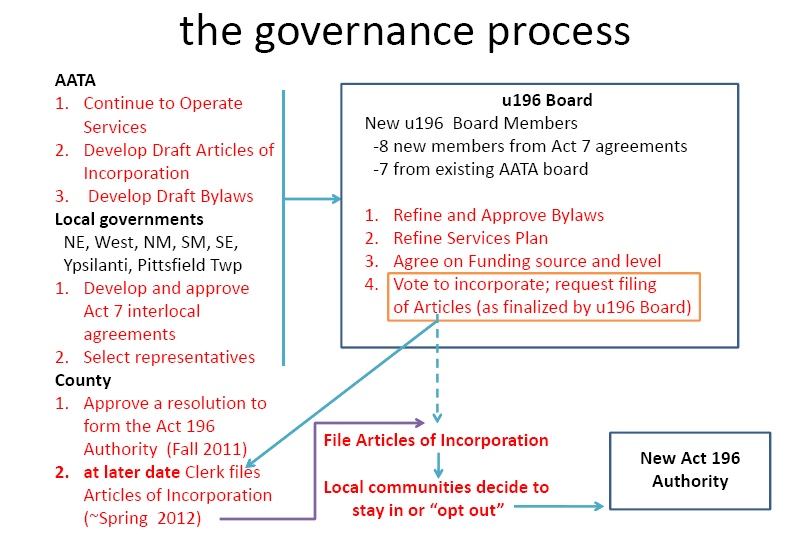
From a June 2011 AATA board retreat

In August, the AATA board released the third volume of the TMP, the funding report.  (See links to this voluminous report on the Chronicle’s account of the meeting.)   They also released the names of the financial committee who are tasked to review options for funding the ambitious TMP.  It is a roster of the powerful and influential.

The committee, which met for the first time on September 16, set an ambitious schedule.  From the Chronicle account:

“Berriz told members of the group at the Sept. 16 meeting that they will meet three more times, and will produce a white paper by the end of the year.”

This seemed headed toward an obvious result.  Though the funding report suggested many possible options, quite a few of them are not possible under current Michigan law, which severely restricts the ability of local governments (including authorities) to levy taxes.  Very nearly the only type of tax available to localities is the property tax.   (As we explained in an earlier post, AATA is currently supported in part by a millage paid by Ann Arbor taxpayers.)

From a June 2011 AATA board retreat

Given the alternatives, I thought that the finance committee’s chief function would be to bless and promote a county-wide millage campaign for the fall of 2012.  This was further supported by a remarkable exchange that occurred at a September Planning and Development Committee meeting where the anticipated deficit budget was discussed.  The following is a paraphrase, not an exact quotation. It followed the explanation by Phil Webb, AATA controller, about the deficit budget, which would entail dipping into reserves.

Rich Robben: We won’t be able to follow this mechanism (dipping into reserves) next year.  We’d better pull some rabbits out of a hat.

Michael Ford: I’m looking at finding some rabbits.

Phil Webb: There will be a gap between September 2012 and July 2013.

Explanation for that last comment: if a vote over the entire county is held in 2012 (most likely in November) that affirms a new millage, that will not be levied until the 2013 tax year.  This means that until taxes are collected in July 2013, no revenue would be available.  (We explained some of this at length in a post about a city income tax.)  But the AATA, which uses the Federal tax year (October-October), would have to pass a new budget in September 2012 in advance of the millage vote.  So not only will the AATA have to pass a new year’s budget without a certainty that a countywide millage will pass, but three-quarters of a year will pass before revenue will be realized from a successful millage vote.

But wait! It gets more exciting.  The story will continue.

Heritage City Place Row

October 24, 2011

It’s about values.

These pictures, from a city staff report, are of the seven historic structures (houses) that occupy the land where a development, called City Place or Heritage Row, has been under discussion over the last (almost) four years.  Click on each for a larger image. For a more comprehensive photographic overview of the area and a description of the history of the area, see the report from Fourth and Fifth Avenue Historic District Study Committee.

It seems it has been going on forever.  Now the fate of those seven houses on South Fifth is once again in the balance and things are moving faster than the Ann Arbor Chronicle’s story schedule can quite accommodate.   In its recent story, Council Moves on Future of Fifth Avenue, the Chronicle reported on a Council action that was already superseded by the course of events.  After extracting some special favors from Council for the City Place “by right” project, developer Jeff Helminski announced that the generous offer from Council made the same night (parking in city structures, yet) would not revive Heritage Row (see our  history from two years ago). This has led 5th Ward CM Mike Anglin to a try for a last-minute save at tonight’s Council meeting.  Amid a confusing welter of resolutions on tonight’s agenda  (some of them relate to the actions of Council at the last meeting, that have been superceded by recent events) are two new ones:  a proposal to appoint a new historic district study committee  (it would build on the results of the previous Fourth and Fifth Avenue Historic District study, and evidently consider a larger area, the South Central Historic District ) and a building and demolition moratorium to keep the structures intact while the historic district is revisited.  This is an echo of the action taken by Council two years ago (see our post, Legislative Legerdemain [and City Place]).

There have probably been a number of mistakes made on all sides through this saga, but the battle for these houses is still worth fighting.  Why should Council be willing to take more steps (in opposition, I gather, to advice from the City Attorney’s office, always litigation-shy)?  It’s a question of competing values, partly of how we balance private property rights against community interest.

Here is a thought experiment.  Suppose that you, as an enormously wealthy individual, purchase a classic work of art, beloved by the world as part of our common cultural heritage.   Are you entitled to destroy it?  Or maybe it is a business decision and you sell it at a nice profit to someone who has announced plans to destroy it.  This is, of course, one of those stupid hypothetical ethical dilemmas that people often pose to make a rhetorical point.  Artwork that has achieved that status is usually too valuable to be destroyed deliberately, though it has happened.  Yet it is true that most people of any cultural sensitivity are horrified at the idea because we have a communal sense of ownership of such artwork.

In a real sense, the same phenomenon is happening when historic structures (especially those that have retained their physical beauty) are razed or seriously altered.  We are all a little impoverished.  But is it reasonable to ask a private property owner who hopes to make some real cash from the property to acknowledge our sense of communal ownership? Yes, for several reasons.

1. Loss of a large swath of buildings alters the future course of an entire area.

Although neighborhoods and neighborhood interests have been derided by those who oppose them, they anchor our city and they are where we live.  The South Central area is one of the neighborhoods within the Central Area that has been under attack by those who would expand downtown uses into it. This is a real conflict of values, as those who would like to make money by expanding Downtown and also those who believe there are issues of equity and access would welcome a transition from a neighborhood to a denser urban fabric.  But replacing a whole swath of architecturally attractive houses with what amounts to a cell block would be a devastating blow to the future integrity of the entire neighborhood.

2. The communal interest in limiting rights of property owners is well established in law and practice.

The whole point of zoning and community standards regulations is to limit the rights of property owners where they threaten the common good and the rights of adjacent or nearby property owners.  For example, the city just recently announced that it will enforce the graffiti ordinance more stringently.

3. The historic buildings are a real economic asset to the entire city.

Perhaps most telling in these difficult times is the argument that all of Ann Arbor stands to lose economic benefit from the destruction of this attractive area.  Donovan Rypkema, who has spoken in Ann Arbor and many other places on the economic benefits of historic preservation, makes the point that over time the most successful urban areas (i.e. those that attract people who will lift the economic climate) are those that maintain historic and architecturally significant structures.  They are part of the “quality of life” indicators that attract innovators, young entrepreneurial and creative people who will help the region be successful.  Ask yourself: what do you see first in pictures of “lovely Ann Arbor” that seek to entice visitors and investors?  You’ll see pictures of our historic Main Street with maybe the Law Quad thrown in.

Let’s not lose our common heritage and future asset by mowing down those houses.

UPDATE: In what was not a particularly surprising outcome, the Council failed to pass CM Anglin’s “Hail Mary” maneuver.  We’ll just have to hope that a miraculous recovery of some other kind saves the seven houses, and the past and future, and everything.

SECOND UPDATEOn request, here is a visualization of City Place.  I don’t know that it represents the current plans, since the developer successfully requested amendments to the site plan that include a greater building height.

City Place front elevation, from the site plan. Click for larger.

There will be two of these buildings, with a parking lot in between.

City Place site plan. Note adjacent dwellings. Click for larger.

Again, the landscaping plan has been altered. Look at the mass of the buildings in comparison to the other dwellings behind it.

THIRD UPDATE:  Paula Gardner writes in today’s AnnArbor.com with an interesting and thought-provoking set of “lessons learned” about this project and its history.  
FOURTH UPDATE:  AnnArbor.com reports on the dismantling of the residences for architectural salvage.  (November 7, 2011)

FIFTH UPDATE: In fall 2015, City Place still has some spaces open after student move-in – an ominous indication.  Here is their site describing room plans and rates. Most rooms are still being rented for about $1000 per month.

Transition Exits Ann Arbor

October 3, 2011

A little more than two years after Transition (a worldwide movement) introduced itself to Ann Arbor,  the local group has announced (via its email listserv) that it is disbanding.

After much deliberation and collective soul searching, we are writing to let you know that the initiating team of Transition Ann Arbor is officially disbanding.   We believe it is important to announce this widely so that we can release the effort into the hands of others, should there be a future groundswell of committed individuals.  

Some challenges we faced were the usual ones, such as personal time constraints and life circumstances. But there were other challenges that we didn’t anticipate, such as the fact that the Transition model has proven difficult to implement in a city the size of Ann Arbor without staff or a strong ties to an existing 501c3 nonprofit.  

We are excited to see the growth of Transition-related efforts in the Ann Arbor community and region. We continue to believe that there is a role for an umbrella organization that strengthens these efforts and develops cohesive plans, action groups, programs, and messages that help our community prepare for the long emergency–the impacts of peak oil, climate change, and economic instability. Unfortunately, we don’t have the necessary resources (or person-power) to make this happen. We have a wealth of accumulated knowledge and lessons learned from our efforts over the last 2 years, including the beginnings of an energy descent action plan. To improve future organizing, we would be happy to share our insights and resources with anyone interested in picking up similar work.

As might be understood from this statement, Transition was founded to support the worldview of those, such as former Environmental Commission chair and mayoral candidate Steve Bean, that we in Ann Arbor (the country, the world) are facing a future singularity in which conditions of life will change drastically.  (The reference to the “long emergency” is a direct reference to the dystopian classic, The Long Emergency by James Howard Kunstler.)  Transition Ann Arbor has been especially notable for its “reskilling festivals” in which such skills as sock darning, keeping bees, and other domestic crafts are taught.  According to the announcement, these will continue under the guidance of their organizer, Laura Smith (lolo730@yahoo.com).

A core concept that Transition and similar efforts are based on is “peak oil”, a belief that the world economy and our very way of life will shift dramatically once the cost of energy increases because of dwindling oil supplies.  The data for peak oil are fairly unambiguous and (discounting the possible effect of shale oil) it appear that the point at which oil supplies begin to dwindle is in the next decade (by 2020).   Lester Brown and the Earth Policy Institute have been promulgating news of this and related impending disasters (most having to do with resource depletion of various kinds) for years.  Yet there are doubters and deniers like Michael Lynch (though these arguments are rebuttable).  Problem is, a worldview in which a collapse is imminent definitely undercuts the current growth paradigm and interferes with business as usual.  We’d really rather not be bothered as long as it looks as though things will go along much as they have since most of us can remember.

We all got a bit of a wake-up call with the economic cataclysms of 2008 and 2009. Though Kunstler has not changed his views or his predictions,  what seemed so imminent during the few months following the crash of 2008 now seems to have retreated a bit over the horizon.  It’s a little hard to get excited over darning your own socks when socks made in East Asia are still available at discount stores at pretty decent prices.  Admittedly, lots of people are out of a job, but gas prices seem to have stabilized.  And though food prices have gone up a little, we can still get most of everything we want and the expensive restaurants in downtown Ann Arbor seem to be doing a booming business. This means that choosing “local food” and making your own still appears to be just that—a choice.

Since one of my own interests and concerns is community food security, I was glad to see that Transition Ann Arbor is passing along its modest treasury to Growing Hope.  But otherwise we are left with pale washed-out “sustainability” efforts like the Ecology Center’s 350.0rg  and the UM’s “M Planet Blue“, which basically tinker around the edges with time-honored environmental fixes (all good).  It’ll perhaps be a little while longer before we have a group in Ann Arbor that really sounds a singular alarm.  If that is going to be you, you are invited to contact Jeannine Palms (jeannine@wetmeadow.org), one of the organizers and a longtime community activist.