


David Nacht at a March 2012 AATA Board meeting
A long road to countywide transit comes to an abrupt end. Why?
Just as governance has been a critical issue for the proposed Southeast Michigan Regional Transit Authority (discussed in our previous post), it has also been a key factor in the development of a Washtenaw County regional (county-wide) authority. Under the leadership of David Nacht, the previous Chair of the Ann Arbor Transportation Authority, AATA has been working toward this goal since the board took a straw vote in May 2008 to become a regional authority. We described some of those early efforts in our December 2009 post, AATA’s Uncertain Future. Nacht led the AATA to consider several models of governance for a regional authority, including one in which the City of Ann Arbor (supported by its perpetual transit millage) would remain separate, but cooperating, with the rest of the county, while the “out-county” would enact its own millage for the regional service. This “donut hole” model was set aside for the “layer cake” model in which the City of Ann Arbor’s millage forms the foundation for the entire regional system, with just a little assist from the rest of the county’s municipalities via a new millage. The many twists and turns in the evolution of this proposed system have been discussed in posts on our Transportation Page.
There is an enduring conflict in our country between two firmly held concepts. One is the principle that a local community should be able to determine its own fate (self-determination). The other is the ideal of a regional governance for the common good across the region. As we described in an earlier post, Is Regionalism Really a Good Thing?, this inherent conflict is playing out right here in Washtenaw County. Michigan has a stubbornly vital tradition of local rule. In fact, it’s in our state constitution. The township system of government makes every issue intensely local, with citizens of each township deciding on the level of services and taxation they prefer, while viewing the efforts of other governments (especially, in this county, Ann Arbor) to dictate their activities with suspicion and mistrust. Yet putting a regional authority into place requires, roughly paraphrasing Pittsfield Township Mandy Grewal, that “we all join hands and jump”. The makers of the Washtenaw County regional authority sought to address this conflict by using a blended system of representation. As described in a presentation by Washtenaw Area Transportation Study (WATS) director Terri Blackmore, a combination of population (less-populated townships were combined into larger districts) and financial contribution were taken into account to award seats at the table. (Blackmore was strongly instrumental in developing this scheme.)

District map as presented in December 2011
The thinly populated western townships, along with the city of Chelsea and village of Manchester, were awarded just one seat on a board of 15. Pittsfield Township, with a large partly urbanized population, got one full seat. The tiny population of the city of Ypsilanti earned itself a full seat by voting in a charter millage (about 1 mill) to pay for its service contract (POSA) with AATA. And Ann Arbor, with its fat perpetual millage (now almost 2 mills, down from 2.5 mills), got just under a majority of seats (7 of 15), despite having only about a third of the county’s population.
Contrast this with the system proposed for the SE Michigan RTA in which each participating county was tentatively given the same number of seats. As we discussed in the previous post, awarding seats on the basis of either population or financial contribution has a potential effect of sowing mistrust and doubt. Smaller communities may fear domination by the larger ones, and larger contributors may fear the redistributive effect. Yet awarding seats on the basis of monetary share highlights any perceived inequities in the way those funds are distributed. While the regional approach is presented as cost sharing, it is also inevitably cost shifting. When differential weight is given to monetary contribution, the question then becomes, “Am I getting MY money’s worth?”.
Nevertheless, AATA assembled a “u196” (unincorporated 196) board along those lines. It has been meeting since December 2011. Many of the members are actually township officials, and there seemed to be a fair amount of enthusiasm and support for the idea. They were presented with what appeared to be a carefully thought-out process. AATA staff endured many sessions before the Ann Arbor City Council and the Board of Commissioners, and finally got their Articles of Incorporation approved. They requested that the County file the AOI, which was on October 3, 2012. (See the report by the Ann Arbor Chronicle explaining that moment) Letters were sent to all affected jurisdictions in early October that specified how each one could opt out – or choose to stay in. This should have launched a 30-day window for opting out, but because of some confusion about the legal requirements (summarized by the Ann Arbor Chronicle), Washtenaw County administration sent out a second set of letters, so that the opt-out window was “reset” to December 10.
But even before that final moment, there were indications of trouble with a universal buy-in. Six townships simply refused to participate even at the most preliminary stage. Then, as early as September, AATA board members began referring to the possibility that some communities might opt out and then opt back in later. Comments were made indicating that opted-out communities might be able to retain a seat at the table for the interim, in hopes that they would decide to opt back in. This possibility and some of the legal tangles involved were reviewed by the Ann Arbor Chronicle. According to that account and to comments made by staff on venues such as WEMU radio programs, opted-out communities might come back in up until the (presumably) May millage vote.
At the October 2, 2012 meeting where the AATA board voted to submit the AOI, the new chair of the board Charles Griffiths gave voice to that approach, as quoted by the Ann Arbor Chronicle:
Griffith addressed the possibility of opt outs, by saying that everyone knew that some jurisdictions will not feel ready at this time to join in this effort – but that’s okay, he said. What’s important is that we give it our best shot to provide an opportunity to everyone. He said the AATA had come up with the best that it could to meet the needs that had been identified and expressed through communities across the county. “If, for whatever reason, we didn’t get that right, we can keep working at it,” he said. He characterized this step as the beginning of the journey, not the end. He hoped that as many jurisdictions would cooperate as possible.
The AATA board and administration must have been surprised, however, at the totality of the reaction. Municipalities began voting to opt out almost on receipt of the letter (see the post, Washtenaw County Transit: More Outs than Ins, for more details.) By the end of October, every township, with the exception of Ypsilanti Township, had opted out, as had many villages and cities. Among cities and villages, only the cities of Ann Arbor, Ypsilanti and Saline remained. (Saline passed a resolution affirming its intention of joining the authority.) The Village of Dexter postponed its decision.

Remaining (green) and opted-out (red screen) communities in Washtenaw County as of October 30, 2012. Dexter Village had not voted.
What Happened?
So why did most Washtenaw County communities opt out after sending representatives to nearly a year’s worth of meetings, many of whom were very encouraging about the process and even allowed their images to be used in promoting it? One reason is that they simply didn’t have much to gain by joining.

Summary map for Washtenaw Ride services as of September 2012 (click for larger version)
As seen in this map, most townships were offered very limited services. (Poor Bridgewater counted for so little that is covered up, as is most of Saline Township.) They were offered vanpools (AATA has already moved to take over this service from a previous operator) and enhanced service from WAVE (a contractor; the green lines). The red lines are express buses that have limited stops and times and are mostly designed for 9-5 commuters into Ann Arbor. The larger villages and cities have a local circulator (blue). Otherwise, most bus services and even the demand services like Dial-a-Ride are limited to the urban area.
As we have outlined earlier, most townships have a very low operating millage rate, by design. The millage for the countywide authority has been forecast to be 0.58 mills, though that was subject to revision depending on how many units opted out. To many Ann Arbor residents, that might not seem too consequential as a standalone amount, as we have many millages for specialized services that have received a popular vote. But to understand county politics, you must understand how large a commitment that seems to many township residents. If they are going to tax their residents even that much, they must receive visible services for that money.
Pittsfield Township trustees were very clear in their discussion prior to opting out, as reported by AnnArbor.com.
The township currently levies a 0.5 mill tax on residents for parks and recreation activities, Grewal said, and prides itself on its low taxes.
Israel stated that he did not believe Pittsfield Township’s participation in the new transportation authority guaranteed the expansion of transit options in the township.
The township’s trustees also noted another feature of the plan: that their township’s taxes would be paying for other services elsewhere.
Israel noted AATA’s proposed express route to Canton Township in its five-year service plan – and said he didn’t think Pittsfield Township voters should be paying out for that kind of service.
On the other hand, Ypsilanti Township, the sole township to stay in the regional authority, will receive expanded bus services and “demand” (Dial-a-Ride) service. (Note the dashed red outline on the map.) Its supervisor, Karen Lovejoy Roe, remarked in a comment on AnnArbor.com’s earlier coverage of the Pittsfield decision that the availability of services for seniors and enhanced ability for workers to get to jobs were important reasons for the township to ask its voters to take on the additional millage.
Mixed Messages
One of the reasons this venture hasn’t quite come together is that there are several different, sometimes competing, messages about why we need county-wide transit. Looked at from a township perspective, they don’t compute.
Connectivity: “Our life does not end at city borders. We should recognize that we are a greater community.” This is a nice sentiment but it is hard to attach dollar value to it. Also, the bus routes provided are not designed for casual travel to other communities, but only for commuting.
Environment: The argument is often made that mass transit will reduce air pollution and global warming. But though this is likely true (and we certainly hope so), there have been some contrary comments about how this really pencils out. Those making the argument for environmental benefit often use the “hand-waving” method, rather than citing data studies. In any case, clearly a substantial ridership is needed for an individual transit vehicle to make a difference; there must be a payback ratio, and this is not discussed much. Certainly no dollar value to local communities is easily attached.
Need: It’s hard to argue with this one, since it is a primary reason to support mass transit. People who have poor access to personal transportation or are low income need to be able to get to work and other places. But the countywide plan really only addresses this for the urban area (Ann Arbor and Ypsilanti areas). As someone from Lyndon Township told me, in order to get to Ann Arbor, they’d have to take WAVE to Chelsea, then take the express bus, and then they wouldn’t be able to get home again later (unless at strictly commuter times), and it would be expensive.
Regional Business Development: This is, in my opinion, one of the primary drivers behind the plan. Notice all those express buses going out of the county to areas that are not paying in? But it would mostly benefit businesses located in the greater Ann Arbor area, and of course the University of Michigan.
And of course, though most of the discussion is about bus services, the county-wide authority is also seeking money to support expensive rail and connector services that will benefit only a very limited population, and centered on Ann Arbor. The townships are rightly suspicious. The idea of paying into a regional pool for something that doesn’t benefit them (or their residents) directly doesn’t match their idea of governance. As we noted some time ago, there has been a suspicion among township residents that this entire scheme was a way to get their money for the benefit of Ann Arbor.
Partners for Transit, a rather informally organized advocacy group for regional transit (it appears to be supported by the Michigan Suburbs Alliance, Conan Smith’s shop), has been making the case that really, the massive opt-out is not a concern because the greatest population of the county will be served. Further, this is where the need is.
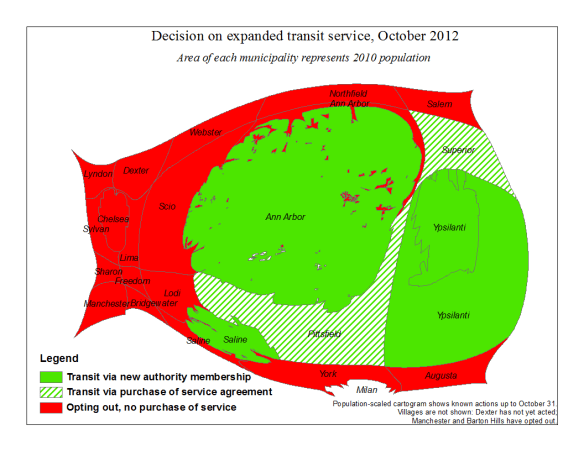
Partners for Transit cartogram representing communities’ areas as a function of population
But though this observation is true enough, it ignores the entire question of governance. An authority limited to these urban communities abandons the idea of “county-wide” transit (and many of the rationales on which it was based) and it will inevitably mean that Ann Arbor is simply subsidizing the two Ypsilanti communities. (The purchase of service agreements shown for connecting townships are not necessarily in place or defined.) Recall that the plan is for Ann Arbor to continue paying 2+ mills, plus the new one, Ypsilanti City to continue its approximately 1 mill, plus the new one, and then Ypsilanti Township would pay only the new millage. It also means that a higher millage (in addition to the existing Ann Arbor and Ypsilanti city millages) would be necessary to achieve that level of service. To get some sense of proportional contribution, see our earlier post in which even with the entire county participating, we would be paying approximately 75% of the cost.
If we wish to subsidize Ypsilanti, surely there is a more efficient way to do it rather than to create a whole new authority with expanded powers but a territory hardly larger than is served under our present system. And there will still be an issue of governance. Would we give the two Ypsilanti communities seats on our joint transit board, even though we are subsidizing their service? They would probably expect that. And how would we allocate them? The same options apply as mentioned earlier: a choice between unitary representation, population-based, or monetary contribution. Each of these has potential political obstacles. If we include the townships that wish to have only a service contract (in which they would pay only the cost allocated to their own service), an even more unequal form of governance might be possible.
Partners for Transit is also stating that Ann Arbor would have a higher level of service, as well. But we could achieve that ourselves, simply by using our existing millage for Ann Arbor rather than to support the many regional and commuter-oriented additions that the AATA board has introduced. Or we could pass an additional millage for our own use.
Regrouping
With all this before them, a good-sized fraction of the Ann Arbor City Council is now preparing to regroup. Tonight (November 8, 2012) has a new agenda item. The resolution to opt out from the Act 196 authority also calls for abrogating the 4-party agreement. (A lengthy discussion and analysis is in this from the Ann Arbor Chronicle.) It contains this language in explanation (click on the text for a larger view):

UPDATE: The Ann Arbor City Council voted 10-0 to withdraw from the Act 196 authority and the 4-party agreement (November 8, 2012). Here are links to news accounts: AnnArbor.com Ann Arbor Chronicle
Michael Ford sent out a news release acknowledging the loss and pointing to future action. He pledged to concentrate on the urban core but also said “Efforts to extend the benefits of transit to a greater number of Washtenaw County residents will continue”. AATA Press Release-New Transit Authority Update