

One impact of the countywide Transit Master Plan is an extra cost to Ann Arbor. What are the others?
On December 12, 2011, AATA CEO Michael Ford presented an overview of the Transit Master Plan to the Ann Arbor City Council. He also discussed the pathway to a countywide authority, which begins with a 4-party agreement that would pledge Ann Arbor’s current transportation millage to the new countywide authority (see diagrams in our previous post). In the Ann Arbor Chronicle’s brief summary of the meeting, several councilmembers raised two questions.
- First, “They wanted to ensure that the burden on Ann Arbor taxpayers would be equitably shared with Washtenaw County taxpayers outside of the city.”
- Second, they “questioned how the transit service benefits to city of Ann Arbor taxpayers would be guaranteed”.
Ann Arbor will bear most of the cost.
As to the first question, the answer is – it isn’t going to happen. Under the most obvious assumptions, Ann Arbor taxpayers will pay nearly two-thirds of the cost of the TMP. It’s a matter both of the larger property valuation and the population. (See assumptions here.)
Here are the approximate percentages that each area would pay with a 1 mill countywide tax, while Ann Arbor and the City of Ypsilanti both continue to collect and donate their current charter millages. (Ann Arbor’s millage was originally 2.5 but has been sinking towards 2; Ypsilanti’s is about 1 mill.)

Another impact on Ann Arbor’s total share of the cost is that with the countywide plan, other local governments would no longer pay the Purchase Of Service Agreement (POSA) charges for their bus service. This POSA income brought $1.3 million into the system in 2011. That means that the millage will have to pick up the difference.
(Please see our post Where the Money Is for a full discussion of the current budget, including the different sources of revenue.)
The actual programs to be supported by this increased millage and their relative costs are hard to get one’s arms around. The Financial Task Force subcommittee has been moving the pieces around a bit and suggesting some priorities and fare changes. What follows is based on the original program budget as proposed.
The urban bus system that incorporates Ypsilanti will become a fully realized network.
In its most recent budget, AATA has already begun to shoulder some of the costs of extending bus service into Ypsilanti. Ford has dismissed concerns that this violates the Ann Arbor charter millage by stating that it benefits businesses in Ann Arbor to be able to bring in workers. Regardless of whether that is a good argument, it makes sense from an urban planning viewpoint to have what is being called the “urban network” of public transit, and the increased service to the urban area east of Ann Arbor is a positive outcome.
The TMP calls for “network enhancements” that include more frequent buses and longer hours. These are a significant part of the 5-year plan and some will benefit Ann Arbor riders. It also calls for better bus stops and “transit hubs”. Apart from longer hours and more frequent buses, few of these improvements will benefit Ann Arbor bus riders directly. Also, the 30-year plan actually calls for eliminating some Ann Arbor bus routes once the high-capacity connector lines are installed.
Both Federal law (assuming a Federal subsidy) and our local preferences call for “demand” services to be furnished wherever fixed-route buses run. The demand services (mostly taxi-based) for handicapped and others needing special access will be expanded through the urban network.
For the purposes of comparison, we have combined fixed-route bus and demand taxi-type service into one category (Urban) for the Ann Arbor area (includes Ypsilanti). The TMP calls for a number of express buses elsewhere in the county (some to points outside the county), some additional fixed-route buses, and enhanced demand service (Countywide) . (Note: percentages will not add to 100% because not all items are included. See the full spreadsheet for more detail.)

But note that the reason for a very high operating cost in Year 30 is that 36% is dedicated to two new systems: commuter rail and high-capacity connector.
Heavy investments in high-capital future projects are a large proportion of costs.
The TMP is a 30-year plan, which means that programs that will not benefit riders until far in the future will start to cost the system much earlier. AATA and its TMP planners are only producing a full financial plan for the first 5 years but there are budgets for the full 30 years that predict a high-cost system that local taxpayers will begin to pay for right away.

The High-capacity, High-demand Connector

click for larger image
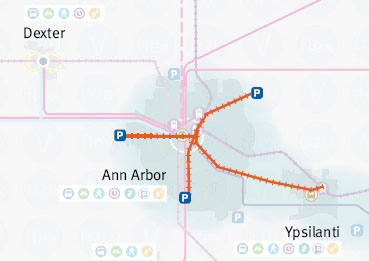
What is that “high-capacity connector”? The Connector Feasibility Study (pdf of large final report linked here) was jointly funded by the City of Ann Arbor, the DDA, the University of Michigan, and AATA. We discussed some of the early planning for it in our post, “Our Shining City on a Hill“. The technology used could be light rail, monorail, gondolas, or bus rapid transit; it hasn’t yet been determined. At this writing, either light rail or BRT seems more likely.
click for larger image
This is now called the “North-South connector” in the TMP. Another high-capacity route, called the “Washtenaw Corridor” (and presumably presaged by Reimagining Washtenaw) is to run from the Jackson-Wagner intersection to the water tower in Ypsilanti.
The purpose is where the money flows
An inescapable conclusion from examining these budgets and the TMP is that it is really two plans. It does have a genuine plan for a better bus system for the Ann Arbor urban area. This is combined with some consolidations of existing service and some commuter-oriented express routes to aim for a partial countywide transit plan. But superimposed on that is a plan to direct our local transit dollars toward supporting two extremely expensive, high-capital transit systems that we do not presently have.
As we have noted several times before, our mayor dreams of trains and has been planning for commuter rail for a long time. The nagging feeling that the TMP is in large part a means to achieve that is only confirmed by his recent comments on AnnArbor.com.
“Hieftje said one of the features he’s most looking forward to is an east-west commuter rail line that will make possible 10-minute trips between Ann Arbor and Ypsilanti.”
As for the Connector system, it is less likely to serve residents of the immediate Ann Arbor area than to assist the University of Michigan system with its needs to move students and employees between campuses and from commuting locations. In fact, its existence is planned to reduce local bus service. During the 5 years of the initial TMP, the amount allocated to this basic service is a flat $20 million per year, but that falls to $16 million at the end because, the consultants explain, riders will be on the high-capacity lines instead. Yet high-capacity lines (designed for rapid transit) are not suitable for local travel within smaller areas of the city.

Actual or budgeted amounts for "Base urban bus service"
Here are some questions that I hope Council will consider before committing our millage and turning over our assets forever.
- Is a “county-wide” (but really a larger region) transit authority the best way to address our immediate urban transit needs (bringing in Ypsilanti)?
- What happens if the high-capital projects are begun with local funds but don’t receive further (Federal) funding?
- What happens if the 5-year plan is launched, but fails to be renewed by the voters just as some of the bills come due for the expanded capital projects?
- Will the new authority be able to issue bonds and thus commit millage and fare revenue to unsustainable big-ticket items? (Bonding for operations is generally not possible, but bonds to support capital projects are common.)
Let the people of the county decide.
A disquieting theme began to emerge in the discussion before Council. It was the suggestion that the countywide authority could be launched without a millage vote. Clearly a millage vote is always a political hurdle. But it sounded as though Ford and Mayor Hieftje were floating a different idea: that the system could attain adequate funding with philanthropic donations and/or new types of fees or taxes (like Governor Snyder’s vehicle registration idea). Here’s what they said, according to AnnArbor.com:
Hieftje said there are influential people on the west side of the state who seem to have the ear of lawmakers in Lansing who are talking about a sales tax to fund transit.
“So I don’t know that we need to think this is going to be a millage at any point,” he said. “I can see how it always comes up, because that’s what people are used to, but there are a lot of other systems of funding transit being talked about right now, and I think we have a governor in place who has proven he’s transit-friendly.
“Ford chimed in with “very much so.”
The council is being promised that, if they sign off on the 4-party agreement, nothing will happen unless until a countywide millage vote passes. Such a vote would necessarily also have to prevail within Ann Arbor itself, thus will reflect the will of the city’s voters as well as those of voters in the rest of the county. But they should take steps to avoid the following scenario:
- The 4-party agreement is signed by all 4 parties.
- The Board of Commissioners approves the Articles of Corporation.
- The new authority board is seated.
- (Some townships might choose to opt out at this point – they have just 60 days.)
- A financial plan is presented that appears to meet budget numbers for the next 5 years. This could be through a combination of donations by parties who have an interest in the development opportunities afforded by the new system, possible new fees including the vehicle registration fee (which is still a long way from being enacted), fare increases, and even maybe some bonds for capital purposes.
- The new authority declares that it has satisfied its financial criteria and moves to acquire AATA assets and lay claim to Ann Arbor’s millage
How likely is this? I don’t know. But please, Ann Arbor City Council, put in safeguards so that a millage vote is required. A move this big needs to have a vote of the people. The ballot is the only effective referendum.
UPDATE: WEMU reports today (December 21, 2011) that the City of Ypsilanti failed to approve its participation in the 4-party plan after Pete Murdock raised issues about the dedication of Ypsilanti’s millage to the countywide plan. Apparently the issue will be revisited.
SECOND UPDATE: Regarding some of the equity issues raised in comments on this post, readers might find the recent article from the Ann Arbor Chronicle of interest. The Chronicle reports on a discussion held at the Financial Task Force subcommittee meeting on relative proportions of service vs. tax contributions.
THIRD UPDATE: AnnArbor.com has an article about an email sent by AATA Executive Director Michael Ford to Council. In it, Ford describes the “benefits to Ann Arbor” of the expanded countywide plan. Here is my analysis of his comments. Perhaps most significantly, many of the benefits he describes are the services that Ann Arbor already receives. He also indicates that Ann Arbor residents would travel conveniently to other cities and villages in the county, but this is not a likely outcome, since what is intended are “express” buses designed for commuters.
Note: This is one of a series of posts on the changing transit visions and plans in Ann Arbor. A list of posts can be found on the Transportation Page, which also has some links and resources.